Drishti Durga Mantra
ॐ दुं दृष्टिदुर्गायै नमःIn Devanagari, Tamil, Telugu, Kannada, Malayalam and English — with the meaning of every word, and the one syllable most people pronounce wrongly.
Who Drishti Durga is
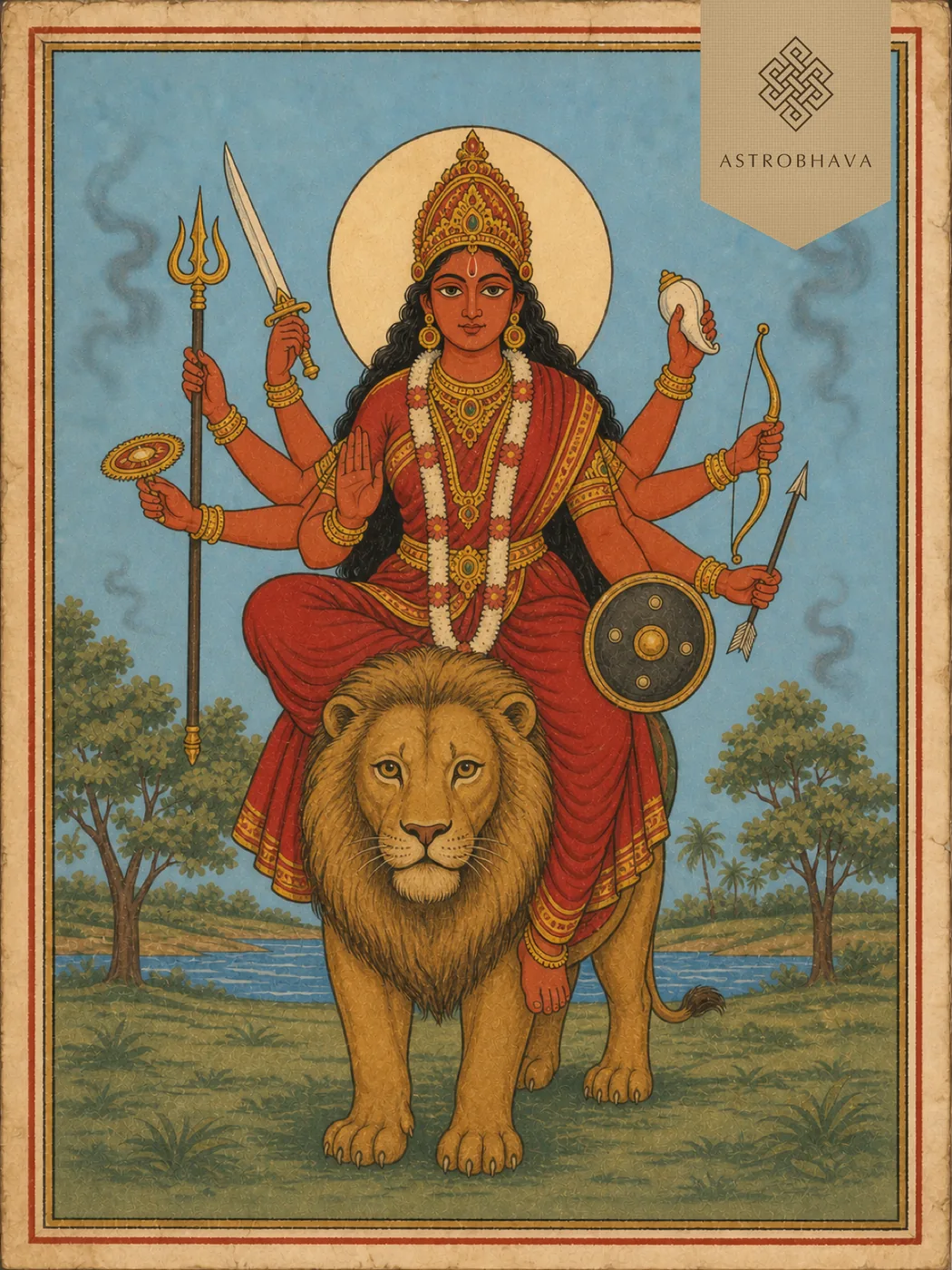
Drishti Durga is the particular aspect of the goddess invoked where the harmful glance—drishti—is understood as a real force that can settle on a person, a child, or a household. She is not a separate deity invented in modern times but a specialised face of Durga recognised in domestic and temple practice across Tamil Nadu, Andhra, and parts of Karnataka, where the evil eye is treated as an affliction requiring a named counter-presence. In this form she is addressed as the one who intercepts and dissolves the concentrated envy or admiration that tradition holds can cling like an unseen residue. Her imagery often retains the lion and the weapons, yet the ritual focus narrows to the eyes: the gaze that wounds and the gaze that unbinds. She remains fully Durga, only oriented toward this single, intimate danger.
The Glance That Bound
South Indian oral and agamic tradition preserves an episode in which a powerful asura, unable to defeat Durga in open battle, cast upon her devotees a glance charged with his remaining tapas. The look did not strike like a weapon but settled quietly, causing prosperity to wither and courage to drain. The goddess, perceiving that the injury travelled through the eyes rather than the limbs, assumed a form whose own gaze could meet and unravel that residue. Texts linked to local Durga shrines describe her as drishti-samharini, the dissolver of the glance, who does not merely shield but actively unpicks the knot of envy. The story is not found in the core Devi Mahatmya yet circulates in sthala puranas and household manuals as the warrant for addressing her under this precise name whenever the affliction of the eye is suspected. It underscores that her power extends to the subtle as well as the spectacular.
The mantra, in six scripts
The seed mantra, and the form most devotees chant daily. No initiation is required — it is open to anyone, including a parent chanting for a child.
- ॐ
- oṃ — the primal syllable
- दुं
- duṃ — seed-syllable of Durga
- दृष्टिदुर्गायै
- dṛṣṭidurgāyai — to Durga of the glance
- नमः
- namaḥ — salutation
The syllable people get wrong
The conjunct ṣṭ in dṛṣṭi demands a retroflex curl of the tongue-tip against the palate; speakers almost always substitute a dental “sht” as in the English “pushed,” which softens the word into something the tradition does not recognise as the technical term for the harmful gaze. The initial dṛ also loses its vocalic r, becoming a plain “dri” that further blurs the precision of the name.
When Drishti Durga is chanted
Weekday. Friday
Questions
Have your chart read before you decide
Chanting is yours to do, and free. But which deity your situation calls for — and whether a mantra alone is the right response — depends on your chart. Sometimes it is; sometimes it is not.
- Over 30 years in the Guru–Sishya Parampara, from the age of five
- He reads every chart himself — 60 minutes, one to one, never delegated
- Charts are read only between sunrise and sunset, following tradition
Related
Chanting is yours to do. Some things are performed for you.
Where a matter carries real weight — an examination that decides a course, a performance, a child whose studies have stalled — devotees sponsor the homa alongside their own practice. Performed for you and any family members you name, at our Yagna Ashram, in your name and gotra, on a muhurta calculated from your chart, and telecast live so you can watch it done for you.