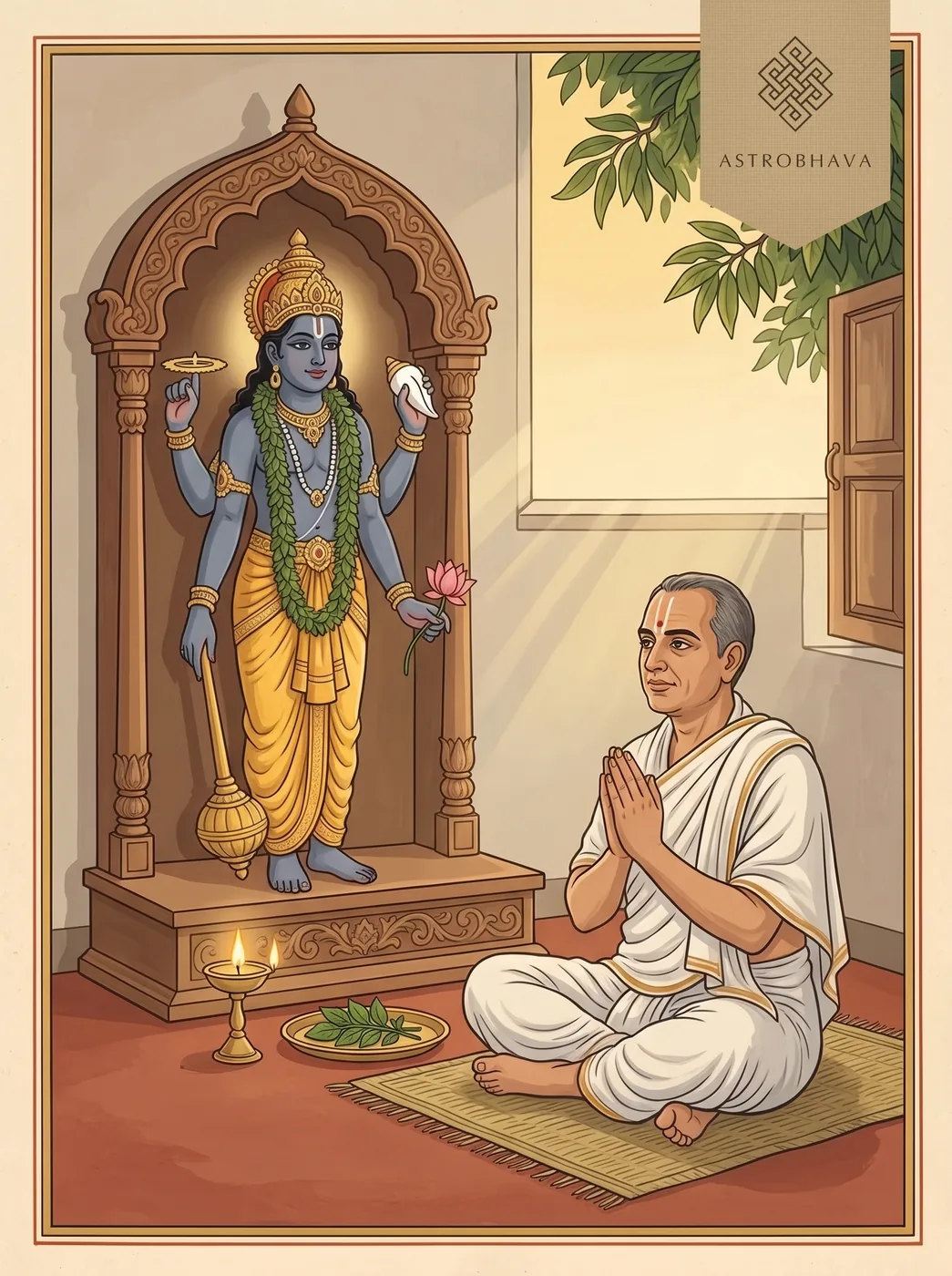
Ekadashi Mantra
एकादश्यां निराहारः स्थित्वाहमपरेऽहनि । भोक्ष्यामि पुण्डरीकाक्ष शरणं मे भवाच्युत ॥Also known as Ekadashyam Nirahara
In Devanagari, Tamil, Telugu, Kannada, Malayalam and English — with the meaning of every word, and the one syllable most people pronounce wrongly.
 The Narayana Sukta Homam, performed for youBook →
What the Ekadashi Mantra is
The Ekadashi Mantra is a pair of Sanskrit shlokas addressed to Vishnu that open and close the eleventh-day fast as the Puranas describe it. Verse 1 is the sankalpa, the spoken resolve: the person keeping the vow says they will stay without food on Ekadashi and eat on the following day, and asks Vishnu, called Pundarikaksha (the lotus-eyed) and Achyuta, to be their refuge. It stands in the Varaha Purana, chapter 39, and recurs in the Narada, Padma and Bhavishya Puranas, with a reworded form in the Agni Purana. Verse 2 belongs to the next morning. Spoken on Dwadashi before parana, the meal that ends the fast, it hands the finished vow to Vishnu as Keshava: the speaker calls themselves blind in the darkness of ignorance and asks him to turn a gracious face to them and grant the sight of knowledge. The Narada Purana gives it in its Ekadashi chapter, and the Padma Purana repeats it in two places. The Shabdakalpadruma, the nineteenth-century Sanskrit lexicon, quotes the two together under its entry for Ekadashi as the sankalpa mantra and the samarpana mantra of the vrata.
The vow Durvasa and Sanaka taught
In the Varaha Purana the sage Satyatapa asks Durvasa for a way to reach Narayana that needs neither great wealth nor priests learned in the Vedas, one open to people of every varna. Durvasa answers with what he calls a secret. When the Earth, Dharani, sank into Rasatala, she worshipped Narayana through fasts and vows until, in time, he lifted her and set her back in place. In her rite, on the tenth day of Margashirsha, after worship, the fire offering and a clean meal, the observer chews a twig from a milky-sapped tree, meditates on Janardana holding conch, discus and mace, offers water from the cupped hand and speaks the verse; that night they sleep near the image repeating Narayana's name. In this telling the vow is voiced on the eve of Ekadashi. The Narada Purana sets both verses in Sanaka's teaching to Narada. There the first is said on Ekadashi after worship with sandal paste and flowers, and a night vigil of song, music and Purana reading follows. The second is said on Dwadashi after Vishnu is bathed in milk; only then are brahmins fed and the family meal taken in silence. Sanaka goes on to tell of Bhadrashila, a boy on the Narmada who remembered being King Dharmakirti, spared at Yama's court by one Ekadashi fast and vigil he had kept by accident on the river bank.
The mantra, in six scripts
- एकादश्यां
- ekādaśyāṃ — on Ekadashi
- निराहारः
- nirāhāraḥ — without food
- स्थित्वाहमपरेऽहनि
- sthitvāhamapare'hani — having stayed, I, on the next day
- भोक्ष्यामि
- bhokṣyāmi — I will eat
- पुण्डरीकाक्ष
- puṇḍarīkākṣa — O lotus-eyed one
- शरणं
- śaraṇaṃ — refuge
- मे
- me — my
- भवाच्युत
- bhavācyuta — be, O Achyuta
- अज्ञानतिमिरान्धस्य
- ajñānatimirāndhasya — of one blinded by the darkness of ignorance
- व्रतेनानेन
- vratenānena — by this vow
- केशव
- keśava — O Keshava
- प्रसीद
- prasīda — be pleased
- सुमुखो
- sumukho — gracious-faced
- भूत्वा
- bhūtvā — becoming
- ज्ञानदृष्टिप्रदो
- jñānadṛṣṭiprado — giver of the sight of knowledge
- भव
- bhava — be
Ekadashi Mantra lyrics in full
Two shlokas: the vow spoken when the Ekadashi fast is taken, and the offering of the fast to Vishnu on Dwadashi before it is broken.
All 2 verses, in Sanskrit, Tamil, Telugu, Kannada, Malayalam and English, each with its meaning. Choose a script:
Download the Ekadashi Mantra PDFAll 2 verses with their meanings, in Sanskrit. Free to print and keep.
एकादश्यां निराहारः स्थित्वाहमपरेऽहनि ।
भोक्ष्यामि पुण्डरीकाक्ष शरणं मे भवाच्युत ॥
ஏகாதஶ்யாம் நிராஹாரஃ ஸ்தித்வாஹமபரேஹநி ।
போக்ஷ்யாமி புண்டரீகாக்ஷ ஶரணம் மே பவாச்யுத ॥
ఏకాదశ్యాం నిరాహారః స్థిత్వాహమపరేఽహని ।
భోక్ష్యామి పుణ్డరీకాక్ష శరణం మే భవాచ్యుత ॥
ಏಕಾದಶ್ಯಾಂ ನಿರಾಹಾರಃ ಸ್ಥಿತ್ವಾಹಮಪರೇಽಹನಿ ।
ಭೋಕ್ಷ್ಯಾಮಿ ಪುಣ್ಡರೀಕಾಕ್ಷ ಶರಣಂ ಮೇ ಭವಾಚ್ಯುತ ॥
ഏകാദശ്യാം നിരാഹാരഃ സ്ഥിത്വാഹമപരേഽഹനി ।
ഭോക്ഷ്യാമി പുണ്ഡരീകാക്ഷ ശരണം മേ ഭവാച്യുത ॥
ekādaśyāṃ nirāhāraḥ sthitvāhamapare'hani |
bhokṣyāmi puṇḍarīkākṣa śaraṇaṃ me bhavācyuta ||
Having stayed without food on Ekadashi, I will eat on the following day. O lotus-eyed one, O Achyuta, be my refuge.
अज्ञानतिमिरान्धस्य व्रतेनानेन केशव ।
प्रसीद सुमुखो भूत्वा ज्ञानदृष्टिप्रदो भव ॥
அஜ்ஞாநதிமிராந்தஸ்ய வ்ரதேநாநேந கேஶவ ।
ப்ரஸீத ஸுமுகோ பூத்வா ஜ்ஞாநத்ருஷ்டிப்ரதோ பவ ॥
అజ్ఞానతిమిరాన్ధస్య వ్రతేనానేన కేశవ ।
ప్రసీద సుముఖో భూత్వా జ్ఞానదృష్టిప్రదో భవ ॥
ಅಜ್ಞಾನತಿಮಿರಾನ್ಧಸ್ಯ ವ್ರತೇನಾನೇನ ಕೇಶವ ।
ಪ್ರಸೀದ ಸುಮುಖೋ ಭೂತ್ವಾ ಜ್ಞಾನದೃಷ್ಟಿಪ್ರದೋ ಭವ ॥
അജ്ഞാനതിമിരാന്ധസ്യ വ്രതേനാനേന കേശവ ।
പ്രസീദ സുമുഖോ ഭൂത്വാ ജ്ഞാനദൃഷ്ടിപ്രദോ ഭവ ॥
ajñānatimirāndhasya vratenānena keśava |
prasīda sumukho bhūtvā jñānadṛṣṭiprado bhava ||
O Keshava, by this vow be pleased with me, who am blinded by the darkness of ignorance. Turn a gracious face to me and grant me the sight of knowledge.
The syllable people get wrong
Puṇḍarīkākṣa, the lotus-eyed, is often flattened to 'Pundrikaksh': keep all five syllables, puṇ-ḍa-rī-kā-kṣa, with the tongue curled back for ṇḍ, long ī and ā, and a crisp kṣ (k followed by sh) before the final short a.
When the Ekadashi Mantra is chanted
Weekday. Thursday
Festival. Ekadashi, with parana on Dwadashi
Questions
Have your chart read before you decide
Chanting is yours to do, and free. But which deity your situation calls for — and whether a mantra alone is the right response — depends on your chart. Sometimes it is; sometimes it is not.
- Over 30 years in the Guru–Sishya Parampara, from the age of five
- He reads every chart himself — 60 minutes, one to one, never delegated
- Charts are read only between sunrise and sunset, following tradition
