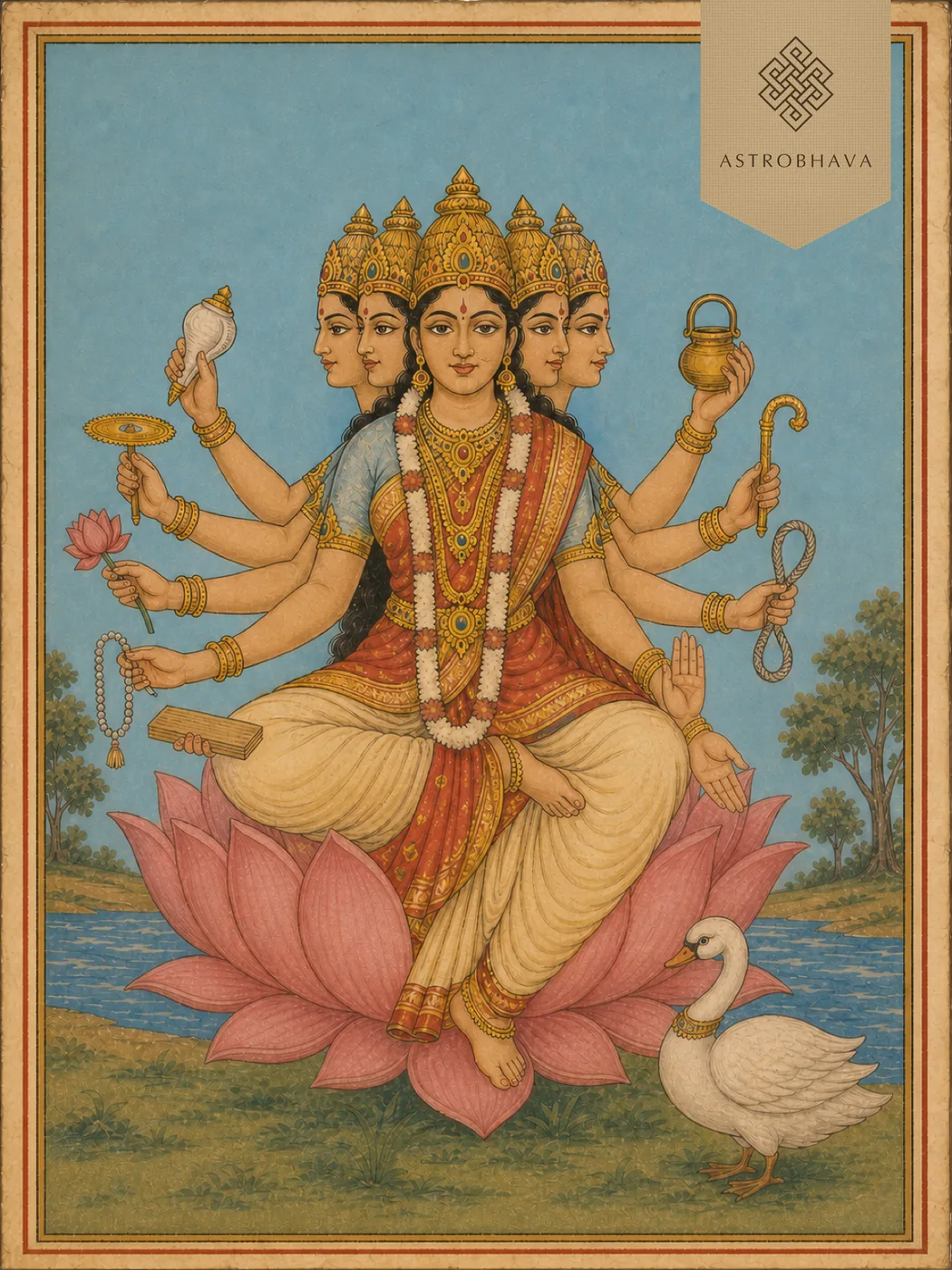
Gayatri Devi Mantra
ॐ भूर्भुवः स्वः तत्सवितुर्वरेण्यं भर्गो देवस्य धीमहि धियो यो नः प्रचोदयात्In Devanagari, Tamil, Telugu, Kannada, Malayalam and English — with the meaning of every word, and the one syllable most people pronounce wrongly.
Who Gayatri Devi is
Gayatri Devi is the Veda-Mata, the mother of the Vedas in personified form, the goddess whose body is understood to be the twenty-four syllables of the Gayatri mantra itself. She is described in the later Puranic and Tantric layers as five-faced and ten-armed, the five faces usually read as the five vital breaths or the five elements, seated on a lotus or on a swan. Where the mantra is the audible revelation, Gayatri Devi is that revelation given a face, a gaze, and a maternal identity. She is not merely a deity to whom the mantra is addressed; she is the mantra’s own luminous person. Worshippers therefore approach her as the source from which the three Vedic vyahritis and the Savitri verse continually arise, the goddess who holds within herself the light of Savitar that the verse contemplates.
The Verse and the Goddess
The verse at the heart of this page is Rig Veda 3.62.10, addressed to Savitar, the impelling power of the sun, and recited with the three vyahritis bhuh, bhuvah and svah. Its metre is the gayatri, and in the later Puranic and Tantric layers of the tradition the verse itself came to be honoured as a goddess, Gayatri Devi, the mother of the Vedas. She is pictured there with five faces and ten arms, seated on a lotus or on a swan. The five faces are usually read as the five vital breaths or the five elements. Devotees understand the twenty-four syllables as her own limbs, so that meditation on the verse and meditation on her form are one act. In this way Gayatri Devi stands as both the mother who gives birth to Vedic speech and the speech that has taken a mother’s shape, remembered daily in the sandhya rites.
The mantra, in six scripts
The name mantra, and the form most devotees chant daily. No initiation is required — it is open to anyone, including a parent chanting for a child.
- ॐ
- oṃ — the sacred syllable
- भूः
- bhūḥ — earth
- भुवः
- bhuvaḥ — mid-space
- स्वः
- svaḥ — heaven
- तत्
- tat — that
- सवितुः
- savituḥ — of Savitar
- वरेण्यम्
- vareṇyam — excellent, to be desired
- भर्गः
- bhargaḥ — splendour, radiance
- देवस्य
- devasya — of the god
- धीमहि
- dhīmahi — let us contemplate
- धियः
- dhiyaḥ — insights, thoughts
- यः
- yaḥ — who
- नः
- naḥ — our
- प्रचोदयात्
- pracodayāt — may he impel
More Gayatri Devi mantras
Gayatri Dhyana Shloka (Muktavidruma)
The verse recited to picture the deity before japa.
- मुक्ताविद्रुमहेमनीलधवलच्छायैः
- muktāvidrumahemanīladhavalacchāyaiḥ — with the hues of pearl, coral, gold, sapphire and white
- मुखैः
- mukhaiḥ — with faces
- त्रीक्षणैः
- trīkṣaṇaiḥ — three-eyed
- युक्ताम्
- yuktām — endowed with
- इन्दुनिबद्धरत्नमुकुटां
- indunibaddharatnamukuṭāṃ — whose jewelled crown is set with the moon
- तत्त्वार्थवर्णात्मिकाम्
- tattvārthavarṇātmikām — whose being is the letters that carry the meaning of reality
- गायत्रीं
- gāyatrīṃ — Gayatri
- वरदाभयाङ्कुशकशाः
- varadābhayāṅkuśakaśāḥ — the boon gesture, fearlessness gesture, goad and whip
- शुभ्रं
- śubhraṃ — white
- कपालं
- kapālaṃ — skull-bowl
- गुणं
- guṇaṃ — cord (rope)
- शङ्खं
- śaṅkhaṃ — conch
- चक्रम्
- cakram — discus
- अथ
- atha — and also
- अरविन्दयुगलं
- aravindayugalaṃ — a pair of lotuses
- हस्तैः
- hastaiḥ — with her hands
- वहन्तीं
- vahantīṃ — carrying
- भजे
- bhaje — I worship
Source: Gayatri Dhyanam, recited in Sandhyavandanam before Gayatri japa. Variants: इन्दुकलानिबद्धमुकुटां for इन्दुनिबद्धरत्नमुकुटां, and गदां (mace) for गुणं (cord).
Gayatri Avahana Mantra (Ayatu Varada Devi)
The verse of salutation, recited before or after japa.
- आयातु
- āyātu — may (she) come
- वरदा
- varadā — boon-giving
- देवी
- devī — the Goddess
- अक्षरं
- akṣaraṃ — the imperishable (also 'syllable')
- ब्रह्मसम्मितम्
- brahmasammitam — equal in measure to Brahman, the Veda
- गायत्रीं
- gāyatrīṃ — Gayatri
- छन्दसां
- chandasāṃ — of the metres
- मातेदं
- mātedaṃ — the mother; this (mātā + idam)
- ब्रह्म
- brahma — prayer, sacred word
- जुषस्व
- juṣasva — accept, be pleased with
- मे
- me — my
Source: Mahanarayana Upanishad (Taittiriya Aranyaka), Gayatri avahana anuvaka (34.1 on sanskritdocuments). It is an invocation (āvāhana) recited in Sandhyavandanam; the kind field says 'pranama' only for lack of a closer category.
The syllable people get wrong
In vareṇyaṃ the retroflex ṇ is followed immediately by the palatal ya, forming the conjunct ṇya. Speakers often reduce it to a simple “nya” with a dental n, saying “varenyam” as if the nasal were ordinary. The tongue must strike the retroflex position before releasing into ya; otherwise the precise Vedic contour of the goddess’s own metre is lost.
When Gayatri Devi is chanted
Weekday. Friday
Festival. Gayatri Jayanti, observed on the Shukla Ekadashi of Jyeshtha in many North Indian calendars
Questions
Have your chart read before you decide
Chanting is yours to do, and free. But which deity your situation calls for — and whether a mantra alone is the right response — depends on your chart. Sometimes it is; sometimes it is not.
- Over 30 years in the Guru–Sishya Parampara, from the age of five
- He reads every chart himself — 60 minutes, one to one, never delegated
- Charts are read only between sunrise and sunset, following tradition
Related
Chanting is yours to do. Some things are performed for you.
Where a matter carries real weight, devotees sponsor the homa alongside their own practice. Performed for you and any family members you name, at our Yagna Ashram, in your name and gotra, on a muhurta calculated from your chart, and telecast live so you can watch it done for you.