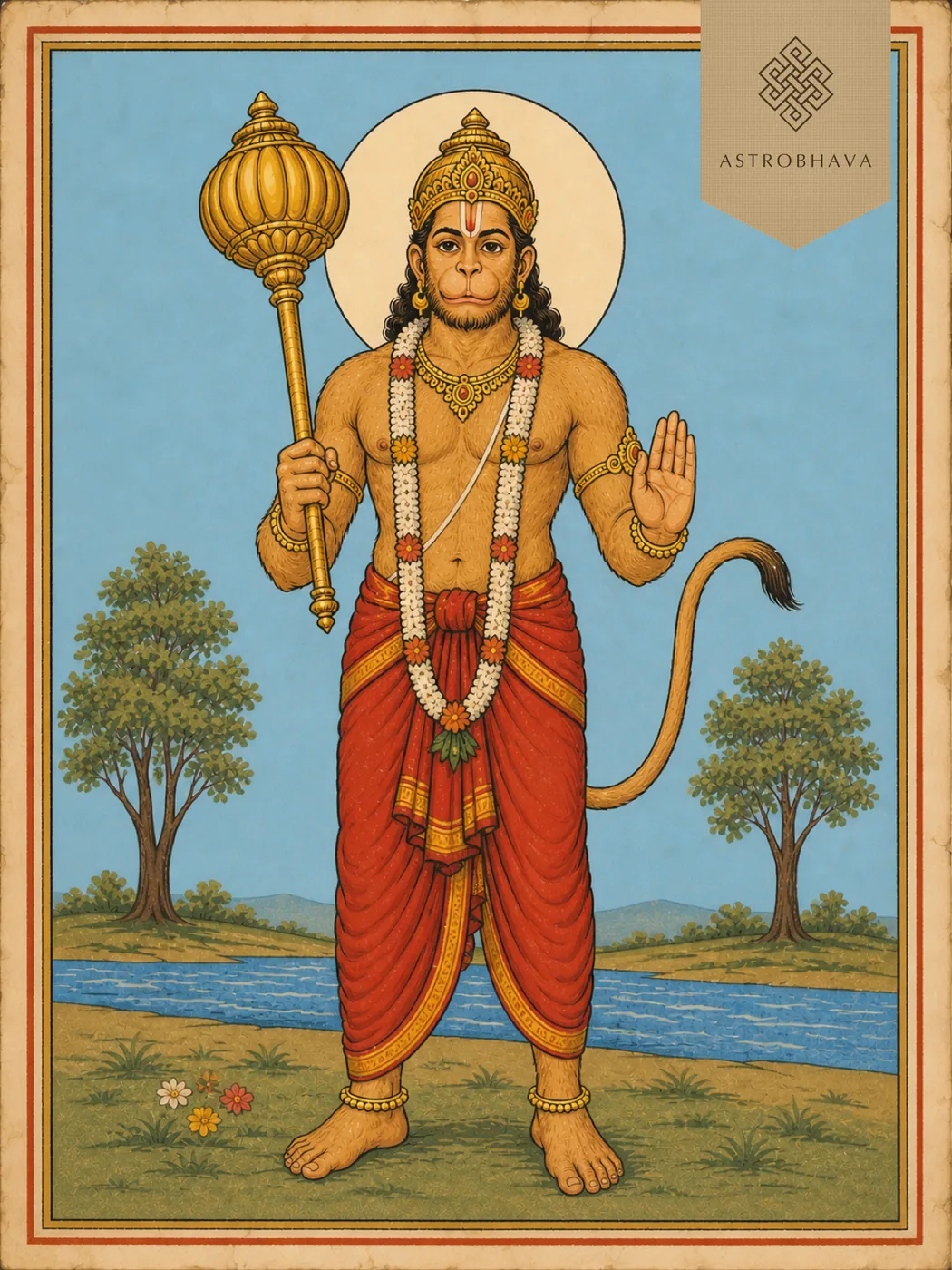
Hanuman Gayatri Mantra
ॐ आञ्जनेयाय विद्महे वायुपुत्राय धीमहि । तन्नो हनुमान् प्रचोदयात् ॥In Devanagari, Tamil, Telugu, Kannada, Malayalam and English — with the meaning of every word, and the one syllable most people pronounce wrongly.
Who Hanuman Gayatri is
Hanuman, addressed in this Gayatri as Āñjaneya and Vāyuputra, is the vanara son of the wind-god and the apsara-born Anjana, whose conception is narrated in the Uttara Kanda traditions and in the Ananda Ramayana. The Gayatri form does not present him with mace raised or chest torn open; it places him inside the ancient Vedic syntax of vidmahe and dhīmahi, the same syntactic frame used for Savitr. Here the intellect is turned toward the messenger who found Sita in the ashoka grove, who spoke Rama’s name into her despair, and who afterwards refused every boon except continued service. The metre itself remains Gayatri—twenty-four syllables arranged for contemplative recitation—yet every epithet is drawn solely from Hanuman’s parentage and from the wind that is both his father and his own nature. No other deity is called both Āñjaneya and Vāyuputra inside a single Gayatri.
Anjana’s Penance and Birth
According to the account preserved in the Ananda Ramayana and echoed in regional tellings of the Shiva Purana, the apsara Punjikasthala was reborn as the vanara woman Anjana after a curse. She performed severe austerities on the mountain later called Anjaneri in order to obtain a son who would be deathless and devoted to dharma. Vayu, the wind, carried to her a portion of the divine pudding that Dasharatha’s queens had received from the sacrificial fire; that portion had been snatched by a bird and fell where Anjana stood in prayer. From that grace Hanuman was born. The Valmiki Ramayana’s Kishkindha Kanda later recalls that the infant, mistaking the rising sun for a fruit, leapt toward it and was struck by Indra’s thunderbolt, receiving the name Hanuman from the injury to his jaw. The same wind that fathered him also healed him, and Brahma and the gods granted the child invulnerability and the boon that he would die only when he himself wished. The Gayatri remembers precisely this double parentage—Anjana’s penance and Vayu’s gift—when it names him Āñjaneya and Vāyuputra before asking that Hanuman impel the intellect.
The mantra, in six scripts
The seed mantra, and the form most devotees chant daily. No initiation is required — it is open to anyone, including a parent chanting for a child.
- ॐ
- oṃ — the sacred syllable
- आञ्जनेयाय
- āñjaneyāya — to Āñjaneya, son of Anjana
- विद्महे
- vidmahe — we know / we seek to know
- वायुपुत्राय
- vāyuputrāya — to the son of Vayu
- धीमहि
- dhīmahi — we meditate upon
- तन्नो
- tanno — may that one (for us)
- हनुमान्
- hanumān — Hanuman
- प्रचोदयात्
- pracodayāt — impel / awaken
The syllable people get wrong
In āñjaneyāya the conjunct ñja demands a true palatal nasal ñ, tongue pressed to the hard palate, before the voiced palatal ja. Speakers routinely substitute a dental n, producing the flattened “anjaneyaya” that erases the nasal colour proper to Anjana’s own name inside the mantra.
When Hanuman Gayatri is chanted
Weekday. Tuesday
Festival. Hanuman Jayanti
Questions
Have your chart read before you decide
Chanting is yours to do, and free. But which deity your situation calls for — and whether a mantra alone is the right response — depends on your chart. Sometimes it is; sometimes it is not.
- Over 30 years in the Guru–Sishya Parampara, from the age of five
- He reads every chart himself — 60 minutes, one to one, never delegated
- Charts are read only between sunrise and sunset, following tradition
Related
Chanting is yours to do. Some things are performed for you.
Where a matter carries real weight — an examination that decides a course, a performance, a child whose studies have stalled — devotees sponsor the homa alongside their own practice. Performed for you and any family members you name, at our Yagna Ashram, in your name and gotra, on a muhurta calculated from your chart, and telecast live so you can watch it done for you.