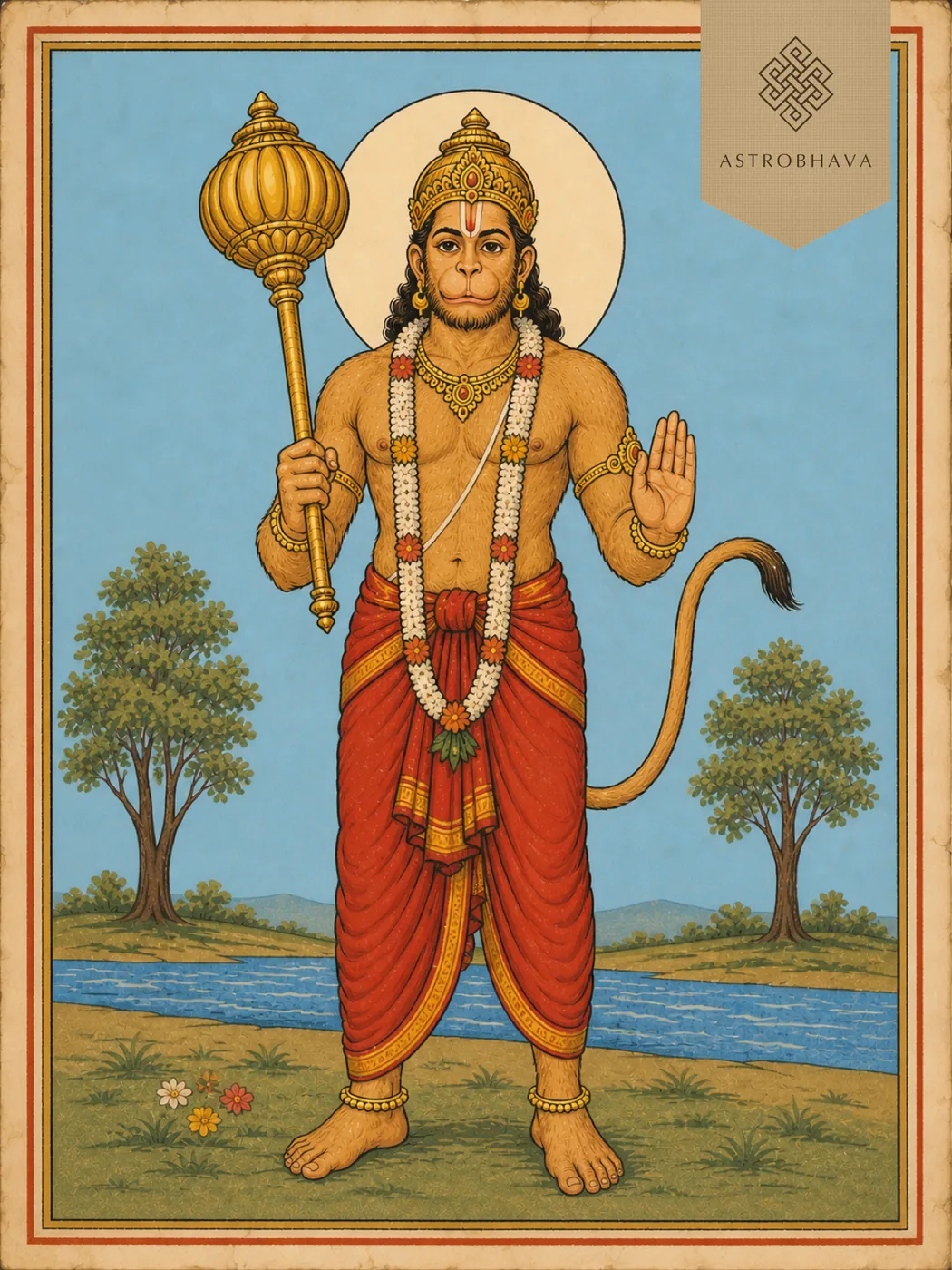
Hanuman Mantra
ॐ हनुमते नमःIn Devanagari, Tamil, Telugu, Kannada, Malayalam and English — with the meaning of every word, and the one syllable most people pronounce wrongly.
Who Hanuman is
Hanuman is the son of the wind-god Vāyu and the ape-mother Añjanā, eternal servant of Rāma and the only figure in the Rāmāyaṇa who crosses the ocean by his own power, locates Sītā in Laṅkā, and returns with her message. The Sanskrit epics and the later Hanuman Cālīsā present him as the one whose body is adamantine, whose mind is fixed on Rāma’s name, and whose devotion never seeks a throne of his own. He is called Māruti after his father, Āñjaneya after his mother, and Rāmadūta when the emphasis falls on his embassy. In temple and household worship the single-faced, standing or flying form is the Hanuman addressed by the principal mantra; that form alone is the subject of this page, distinct from the five-faced tantric configuration known as Pañcamukhī.
The Leap to Laṅkā
Vālmīki’s Rāmāyaṇa, in the Sundara Kāṇḍa, narrates the episode that defines Hanuman for every later tradition. When the search for Sītā reaches the ocean’s edge, the vanaras despair; Jāmbavān reminds Hanuman of the boons given at birth and of his true parentage as son of Vāyu. Hanuman then swells to a colossal size, bows to the elders, and launches himself across the sea. On the way he declines the rest offered by Mount Maināka, outwits the shadow-seizing rākṣasī Siṃhikā, and enters Laṅkā under cover of dusk. He finds Sītā in the aśoka grove, shows her Rāma’s ring, receives her crest-jewel, and only after surveying Rāvaṇa’s court and firing the city does he return. The same kāṇḍa records his modest report to Rāma: he claims no glory beyond having done the work of a messenger. That single crossing and return remain the narrative core of every Hanuman shrine and of the mantra that simply salutes him by name.
The mantra, in six scripts
The seed mantra, and the form most devotees chant daily. No initiation is required — it is open to anyone, including a parent chanting for a child.
- ॐ
- oṃ — the sacred syllable
- हनुमते
- hanumate — to Hanuman
- नमः
- namaḥ — salutation
The syllable people get wrong
In hanumate the second syllable nu carries a short u that must remain light; speakers influenced by the English stress pattern of the proper name “Hanuman” routinely lengthen it to ū, producing “hanūmate” and shifting the rhythmic weight away from the form fixed in the mantra.
When Hanuman is chanted
Weekday. Tuesday
Festival. Hanuman Jayanti
Questions
Have your chart read before you decide
Chanting is yours to do, and free. But which deity your situation calls for — and whether a mantra alone is the right response — depends on your chart. Sometimes it is; sometimes it is not.
- Over 30 years in the Guru–Sishya Parampara, from the age of five
- He reads every chart himself — 60 minutes, one to one, never delegated
- Charts are read only between sunrise and sunset, following tradition
Related
Chanting is yours to do. Some things are performed for you.
Where a matter carries real weight — an examination that decides a course, a performance, a child whose studies have stalled — devotees sponsor the homa alongside their own practice. Performed for you and any family members you name, at our Yagna Ashram, in your name and gotra, on a muhurta calculated from your chart, and telecast live so you can watch it done for you.