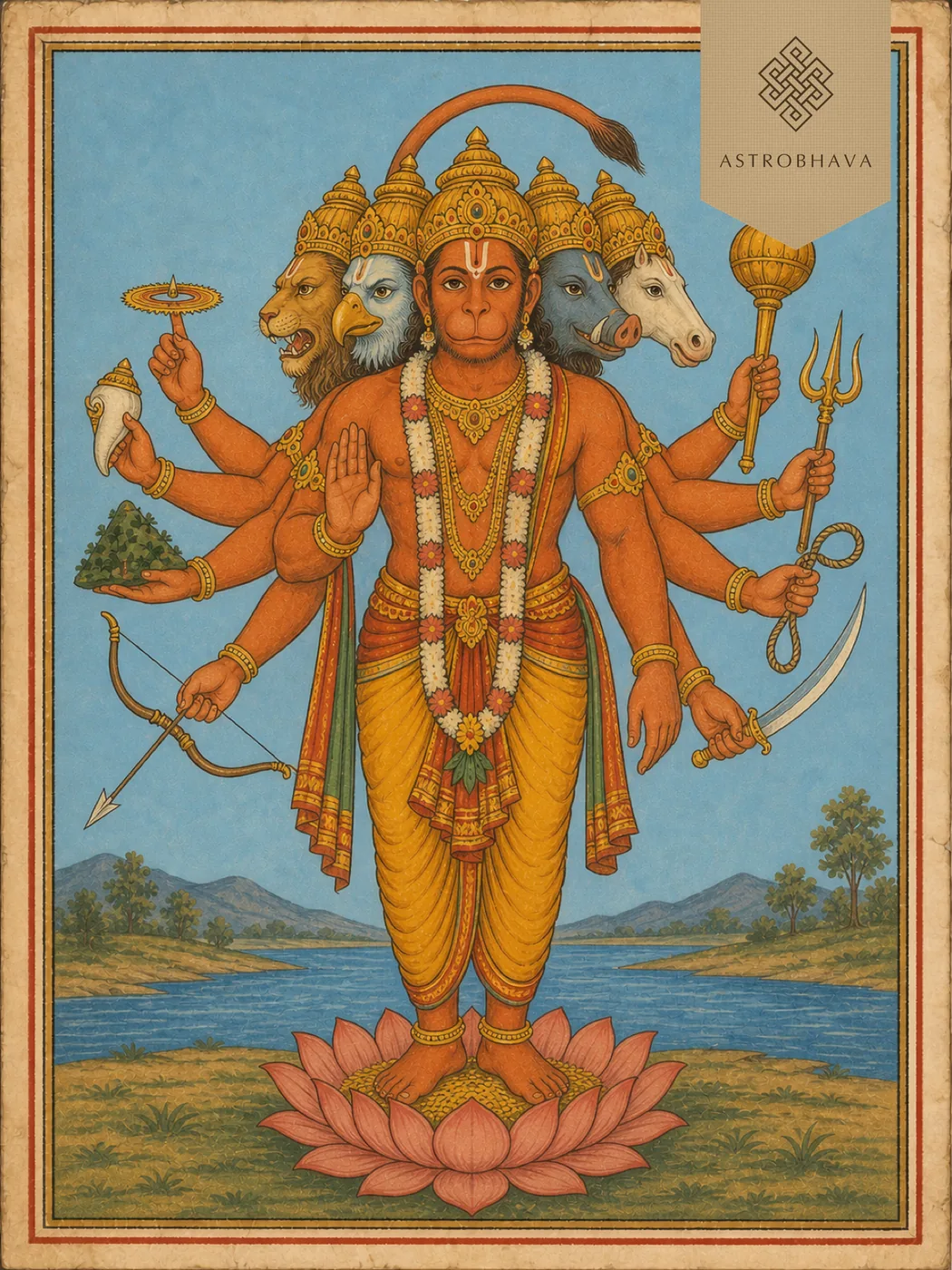
Panchamukhi Hanuman Mantra
ॐ पञ्चमुखाय हनुमते नमःIn Devanagari, Tamil, Telugu, Kannada, Malayalam and English — with the meaning of every word, and the one syllable most people pronounce wrongly.
Who Panchamukhi Hanuman is
Pañcamukhī Hanuman is the five-faced tantric manifestation of Hanuman in which the east-facing head remains the familiar monkey face while the south face is Narasiṃha, the west Garuḍa, the north Varāha, and the upward face Hayagrīva. The form is described in certain tantric paddhatis and in the ritual handbooks of temples that maintain a separate Pañcamukhī shrine, most famously at the site linked to the Ahirāvaṇa episode. Each face is held to preside over one direction and to embody a distinct divine power placed at Hanuman’s service. Unlike the single-faced Hanuman of the Vālmīki Rāmāyaṇa, this configuration is invoked only when the five-headed icon or yantra is the focus of the rite; the mantra therefore addresses him expressly as pañcamukha, the five-faced one, and not simply as Hanuman.
Rescue from the Netherworld
A later strand of the Rāma tradition, preserved in regional Rāmāyaṇas and in the tantric manuals that describe Pañcamukhī Hanuman, tells of Ahirāvaṇa, the sorcerer-king of the netherworld, who abducts Rāma and Lakṣmaṇa during the Laṅkā war and prepares them for sacrifice. Ordinary strength cannot open the way; Hanuman therefore assumes the five-faced form so that he may see and act in all directions at once. With the Garuḍa face he counters serpent barriers, with the Varāha face he claims the subterranean realm, with the Narasiṃha face he terrifies the demons, with the Hayagrīva face he destroys the sacrificial knowledge of the enemy, and with his own face he locates and frees the princes. Having slain Ahirāvaṇa he returns by the same five-fold power. The episode is not found in Vālmīki’s text; it belongs to the expansive vernacular and tantric cycles that supply the mythic charter for every Pañcamukhī image and for the mantra that names the five faces together.
The mantra, in six scripts
The seed mantra, and the form most devotees chant daily. No initiation is required — it is open to anyone, including a parent chanting for a child.
- ॐ
- oṃ — the sacred syllable
- पञ्चमुखाय
- pañcamukhāya — to the five-faced one
- हनुमते
- hanumate — to Hanuman
- नमः
- namaḥ — salutation
The syllable people get wrong
The palatal nasal ñ in pañca is formed with the tongue against the hard palate before the c; speakers commonly replace it with a dental n, so that pañcamukhāya is pronounced “pancamukhāya” and the proper nasal of the five-faced name is lost.
When Panchamukhi Hanuman is chanted
Weekday. Tuesday
Questions
Have your chart read before you decide
Chanting is yours to do, and free. But which deity your situation calls for — and whether a mantra alone is the right response — depends on your chart. Sometimes it is; sometimes it is not.
- Over 30 years in the Guru–Sishya Parampara, from the age of five
- He reads every chart himself — 60 minutes, one to one, never delegated
- Charts are read only between sunrise and sunset, following tradition
Related
Chanting is yours to do. Some things are performed for you.
Where a matter carries real weight — an examination that decides a course, a performance, a child whose studies have stalled — devotees sponsor the homa alongside their own practice. Performed for you and any family members you name, at our Yagna Ashram, in your name and gotra, on a muhurta calculated from your chart, and telecast live so you can watch it done for you.