Kalaratri Mantra
ॐ देवी कालरात्र्यै नमःIn Devanagari, Tamil, Telugu, Kannada, Malayalam and English — with the meaning of every word, and the one syllable most people pronounce wrongly.
Who Kalaratri is
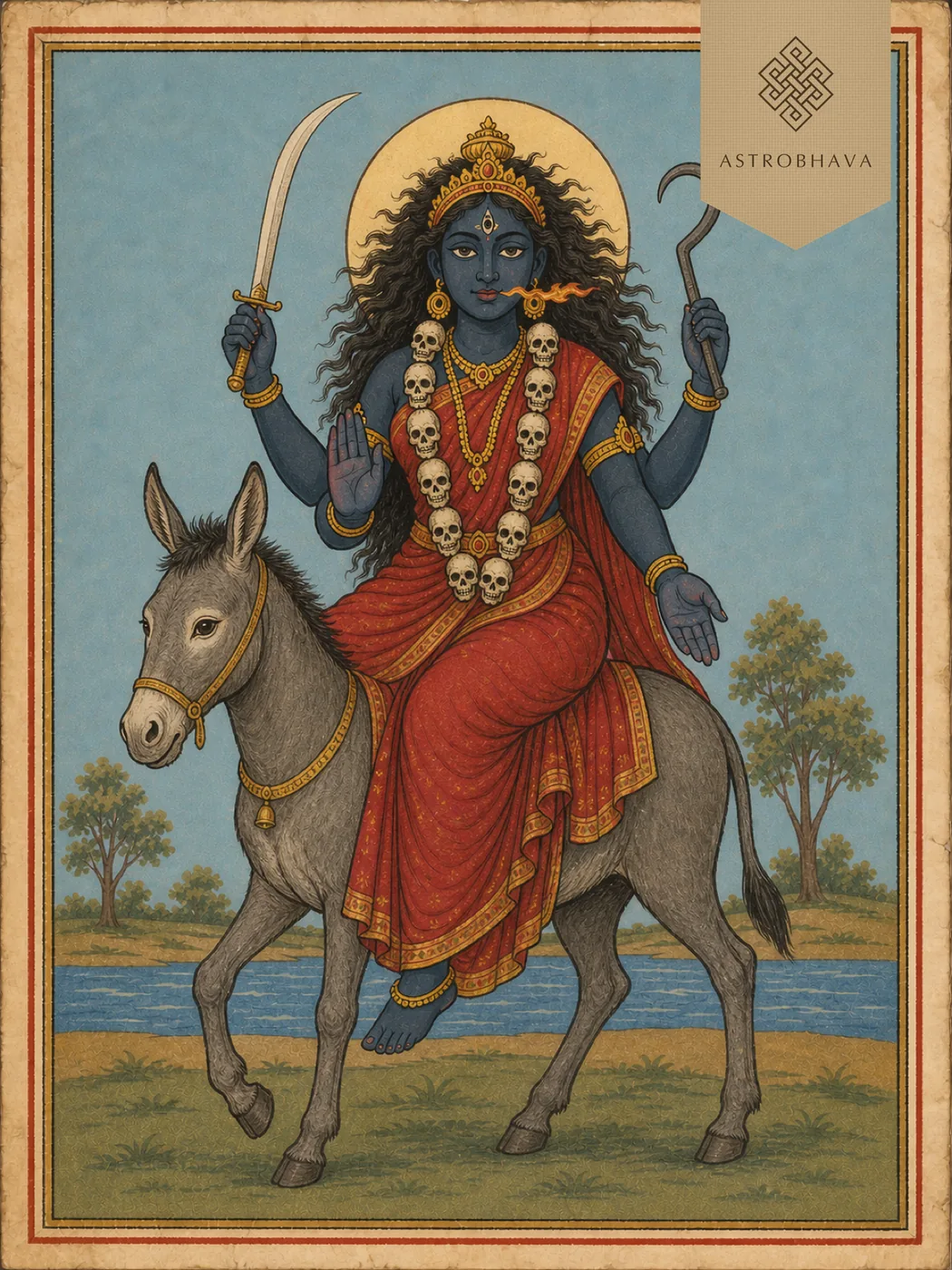
Kalaratri is the seventh of the Navadurgas, the night-of-time goddess whose skin is dark as the dissolving kalpa and whose hair falls unbound like storm cloud. She is the form who rides a donkey, holds the iron thorn and the cleaver, and is propitiated on the seventh night of Sharada Navaratri. Unlike gentler Parvati forms she is invoked as the power that ends the asura’s lease on fear itself. The Devi Mahatmya and later Navadurga paddhatis place her after Katyayani and before Mahagauri, marking the turn from battle fury toward the quiet that follows annihilation. Her name joins kāla, destructive time, with rātri, the night in which all forms are reabsorbed.
Night that ends the asuras
Within the Navadurga sequence drawn from the Devi Mahatmya and regional Upapuranas, Kalaratri appears when the remaining asura forces under Raktabija’s successors still darken the earth. The goddess assumes her most terrible night-body: complexion of the void, disheveled hair, garland of lightning, mounted on a mule. She does not merely slay; she swallows the very darkness the demons had spread, so that fear itself loses its foothold. Traditional accounts emphasize that her emergence is timed to the seventh lunar night, when the waxing dark requires a darkness deeper still to cancel it. After her passage the eighth night can open to Mahagauri’s clarity. The episode is therefore less a single combat than the liturgical hinge of Navaratri, the necessary night that makes the following dawn possible.
The mantra, in six scripts
The seed mantra, and the form most devotees chant daily. No initiation is required — it is open to anyone, including a parent chanting for a child.
- ॐ
- oṃ — the primal sound
- देवी
- devī — goddess
- कालरात्र्यै
- kālarātryai — to the night of time
- नमः
- namaḥ — salutation
The syllable people get wrong
The compound kālarātryai begins with a long kā and places stress on the second long ā of rā; speakers frequently shorten both to ka-la-ra-tri-yai and turn the final tryai into a light tri. Correct pronunciation holds each long ā and releases the try cluster as a single retroflex glide into the dative ending.
When Kalaratri is chanted
Weekday. Friday
Festival. The seventh night of Sharada Navaratri, dedicated to Kalaratri
Questions
Have your chart read before you decide
Chanting is yours to do, and free. But which deity your situation calls for — and whether a mantra alone is the right response — depends on your chart. Sometimes it is; sometimes it is not.
- Over 30 years in the Guru–Sishya Parampara, from the age of five
- He reads every chart himself — 60 minutes, one to one, never delegated
- Charts are read only between sunrise and sunset, following tradition
Related
Chanting is yours to do. Some things are performed for you.
Where a matter carries real weight — an examination that decides a course, a performance, a child whose studies have stalled — devotees sponsor the homa alongside their own practice. Performed for you and any family members you name, at our Yagna Ashram, in your name and gotra, on a muhurta calculated from your chart, and telecast live so you can watch it done for you.