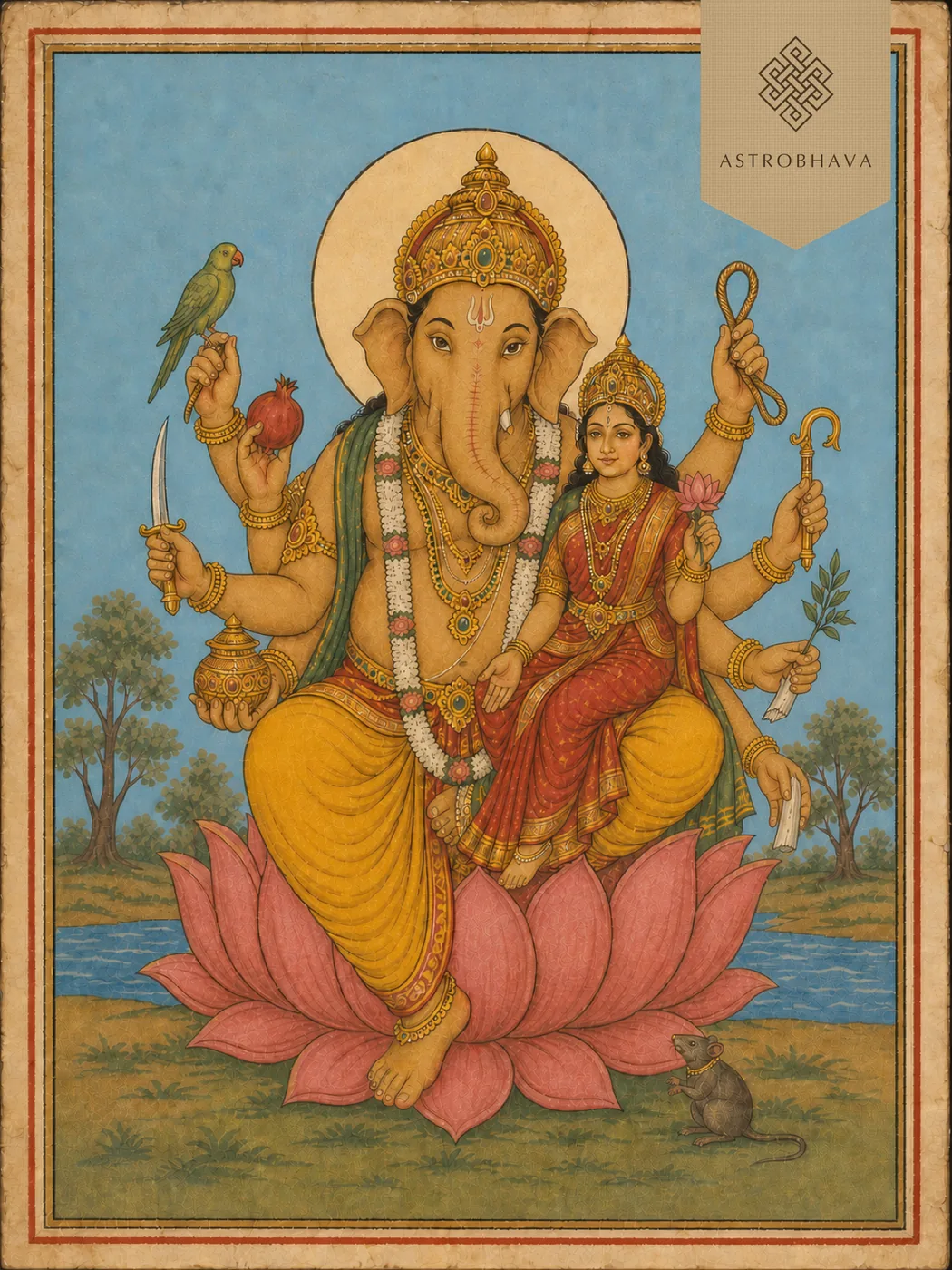
Lakshmi Ganapathi Mantra
ॐ श्रीं ह्रीं क्लीं ग्लौं गं गणपतये वरवरद सर्वजनं मे वशमानय स्वाहाIn Devanagari, Tamil, Telugu, Kannada, Malayalam and English — with the meaning of every word, and the one syllable most people pronounce wrongly.
Who Lakshmi Ganapathi is
Lakshmi Ganapathi is the particular manifestation of the elephant-headed deity in which the goddess Lakshmi is not merely invoked but iconographically present. In the descriptions preserved by the Mudgala Purana and the later tantric paddhatis that enumerate the thirty-two forms, he appears fair-complexioned, often with the goddess seated on his left thigh or standing close enough that her lotus and pot of abundance share the same visual field as his own broken tusk, noose and goad. Tradition locates this form at the point where an obstruction is felt specifically in the sphere of livelihood, stores and the steady movement of means. He is Ganesha understood as the threshold guardian who stands in deliberate conjunction with Śrī, the principle of auspicious amplitude. His additional attributes—the pomegranate, the parrot, the jewel-pot—mark him as the aspect addressed when the question before the household or the merchant is one of sustained provision rather than of travel, learning or battle.
Conjunction with the Goddess
The Mudgala Purana, the principal Sanskrit source that classifies Ganapati into thirty-two distinct forms, presents Lakshmi Ganapathi as the manifestation in which the remover of obstacles is never separated from the bestower of fortune. The text does not supply an independent combat narrative for this form; instead it offers a theological image. He is described as clad in white, four-armed or more, carrying the noose, the goad, the lotus, the pot of jewels, the pomegranate and sometimes a parrot, while Lakshmi herself occupies the place of honour beside or upon him. Later South Indian compilations and temple agamas elaborate the same vision without adding a dramatic episode, treating the form as an eternal statement rather than a once-upon-a-time event. The underlying reasoning is older than the Purana itself: Ganesha governs the doorway, Lakshmi the fullness that may pass through it. When the two are shown together, scripture is declaring that the barrier in question belongs to the domain of means and amplitude. The form therefore functions as a visual exegesis of that joint sovereignty, repeated in stone and bronze across regions where the Mudgala tradition was received.
The mantra, in six scripts
The seed mantra, and the form most devotees chant daily. No initiation is required — it is open to anyone, including a parent chanting for a child.
- ॐ
- oṃ — Om
- श्रीं
- śrīṃ — seed-syllable of Śrī
- ह्रीं
- hrīṃ — seed-syllable of the heart
- क्लीं
- klīṃ — seed-syllable of attraction
- ग्लौं
- glauṃ — seed-syllable of the earth
- गं
- gaṃ — seed-syllable of Gaṇeśa
- गणपतये
- gaṇapataye — to Gaṇapati
- वरवरद
- varavarada — O foremost bestower of boons
- सर्वजनं
- sarvajanaṃ — every person
- मे
- me — to me
- वशमानय
- vaśamānaya — make subject
- स्वाहा
- svāhā — svāhā
The syllable people get wrong
The seed-syllable glauṃ is the distinctive hazard of this mantra. Speakers commonly flatten the diphthong au into a short o, yielding the clipped ‘glom’ or ‘glam’. The correct sound retains the full a-to-u glide before the nasal closure, giving glauṃ its proper weight as the earth-seed; without that glide the syllable loses the character assigned to it in the tantric lists.
When Lakshmi Ganapathi is chanted
Weekday. Tuesday
Questions
Have your chart read before you decide
Chanting is yours to do, and free. But which deity your situation calls for — and whether a mantra alone is the right response — depends on your chart. Sometimes it is; sometimes it is not.
- Over 30 years in the Guru–Sishya Parampara, from the age of five
- He reads every chart himself — 60 minutes, one to one, never delegated
- Charts are read only between sunrise and sunset, following tradition
Related
How to Chant
Mala, counts, timing and the mistakes that apply to any mantra.
Ganapathi Mula Mantra
The foundational mantra. Chanted at the start of any undertaking.
Vidya Ganapathi Mantra
For study, examinations and retention of what is learned.
Lakshmi Ganapathi Homa
The fire ritual, performed for you and telecast live.
Chanting is yours to do. Some things are performed for you.
Where a matter carries real weight — an examination that decides a course, a performance, a child whose studies have stalled — devotees sponsor the homa alongside their own practice. Performed for you and any family members you name, at our Yagna Ashram, in your name and gotra, on a muhurta calculated from your chart, and telecast live so you can watch it done for you.