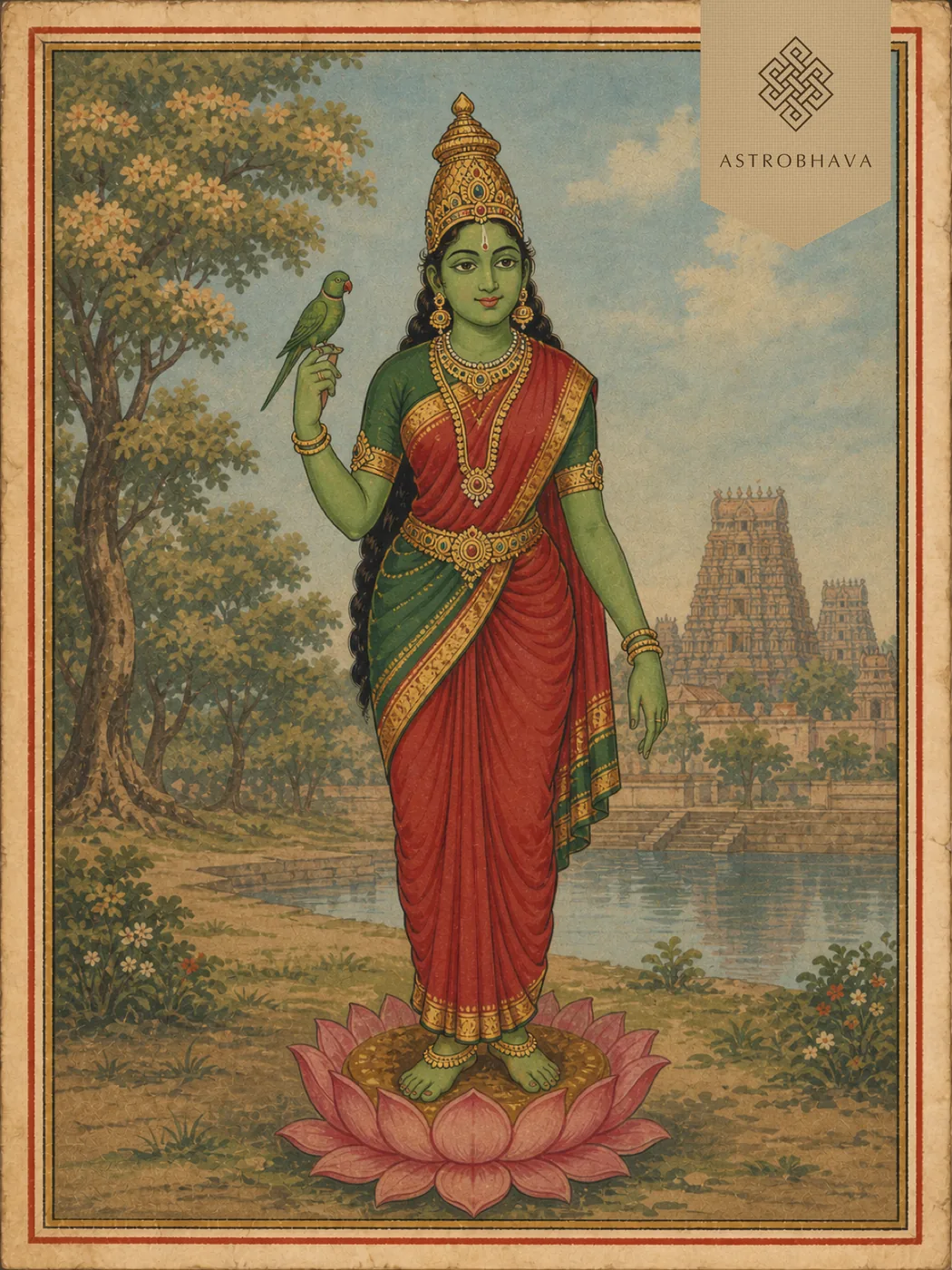
Meenakshi Mantra
ॐ ह्रीं श्रीं मीनाक्ष्यै नमःIn Devanagari, Tamil, Telugu, Kannada, Malayalam and English — with the meaning of every word, and the one syllable most people pronounce wrongly.
Who Meenakshi is
Meenakshi is the sovereign goddess of Madurai, the fish-eyed form of Parvati who shares the throne of the great temple with Sundareswarar yet is addressed first in the daily liturgy. Tamil Shaiva tradition presents her not as subordinate consort but as the Pandya princess who conquered the directions before marriage and whose green-stone image still holds the parrot and the bent sugarcane bow. The name mīnākṣī names eyes shaped like a carp’s, lids that never fully close, keeping watch over the Vaigai plain. Local sthala-purana and the Tiruvilaiyadal Puranam fix her birth to King Malayadhwaja and her three-breasted childhood that ended only when she faced Shiva on the battlefield. In Madurai she remains the city’s reigning queen.
The three-breasted princess
The Halasya Mahatmya and the Tamil Tiruvilaiyadal Puranam recount that the childless Pandya king Malayadhwaja performed a great sacrifice for an heir. From the fire rose a three-year-old girl already bearing three breasts and the cry of a warrior. A divine voice declared that the third breast would vanish only when she met her future husband. Named Tadaatagai and trained in arms, she subdued the quarters until her army reached Kailasa. There she confronted Shiva himself; at the first meeting the third breast disappeared and she knew him as Sundareswarar. Their wedding, celebrated as Meenakshi Thirukalyanam, established the dual sovereignty still enacted each year in Madurai. The narrative is not a generic marriage myth but the charter of the city’s goddess-queen, whose conquest precedes and conditions the union.
The mantra, in six scripts
The seed mantra, and the form most devotees chant daily. No initiation is required — it is open to anyone, including a parent chanting for a child.
- ॐ
- oṃ — the primal sound
- ह्रीं
- hrīṃ — seed-syllable of the goddess’s power
- श्रीं
- śrīṃ — seed-syllable of auspicious radiance
- मीनाक्ष्यै
- mīnākṣyai — to the fish-eyed one
- नमः
- namaḥ — salutation
The syllable people get wrong
The second syllable of mīnākṣyai is a long ī followed immediately by the conjunct kṣya. Speakers often shorten the ī to a short i and separate the kṣ into ka-sha, producing mi-nak-shi-yai. The correct sound keeps the long vowel and releases the kṣ as a single retroflex aspirate before the y glide.
When Meenakshi is chanted
Weekday. Friday
Festival. Meenakshi Thirukalyanam, the celestial wedding festival held in Madurai during Chithirai
Questions
Have your chart read before you decide
Chanting is yours to do, and free. But which deity your situation calls for — and whether a mantra alone is the right response — depends on your chart. Sometimes it is; sometimes it is not.
- Over 30 years in the Guru–Sishya Parampara, from the age of five
- He reads every chart himself — 60 minutes, one to one, never delegated
- Charts are read only between sunrise and sunset, following tradition
Related
Chanting is yours to do. Some things are performed for you.
Where a matter carries real weight — an examination that decides a course, a performance, a child whose studies have stalled — devotees sponsor the homa alongside their own practice. Performed for you and any family members you name, at our Yagna Ashram, in your name and gotra, on a muhurta calculated from your chart, and telecast live so you can watch it done for you.