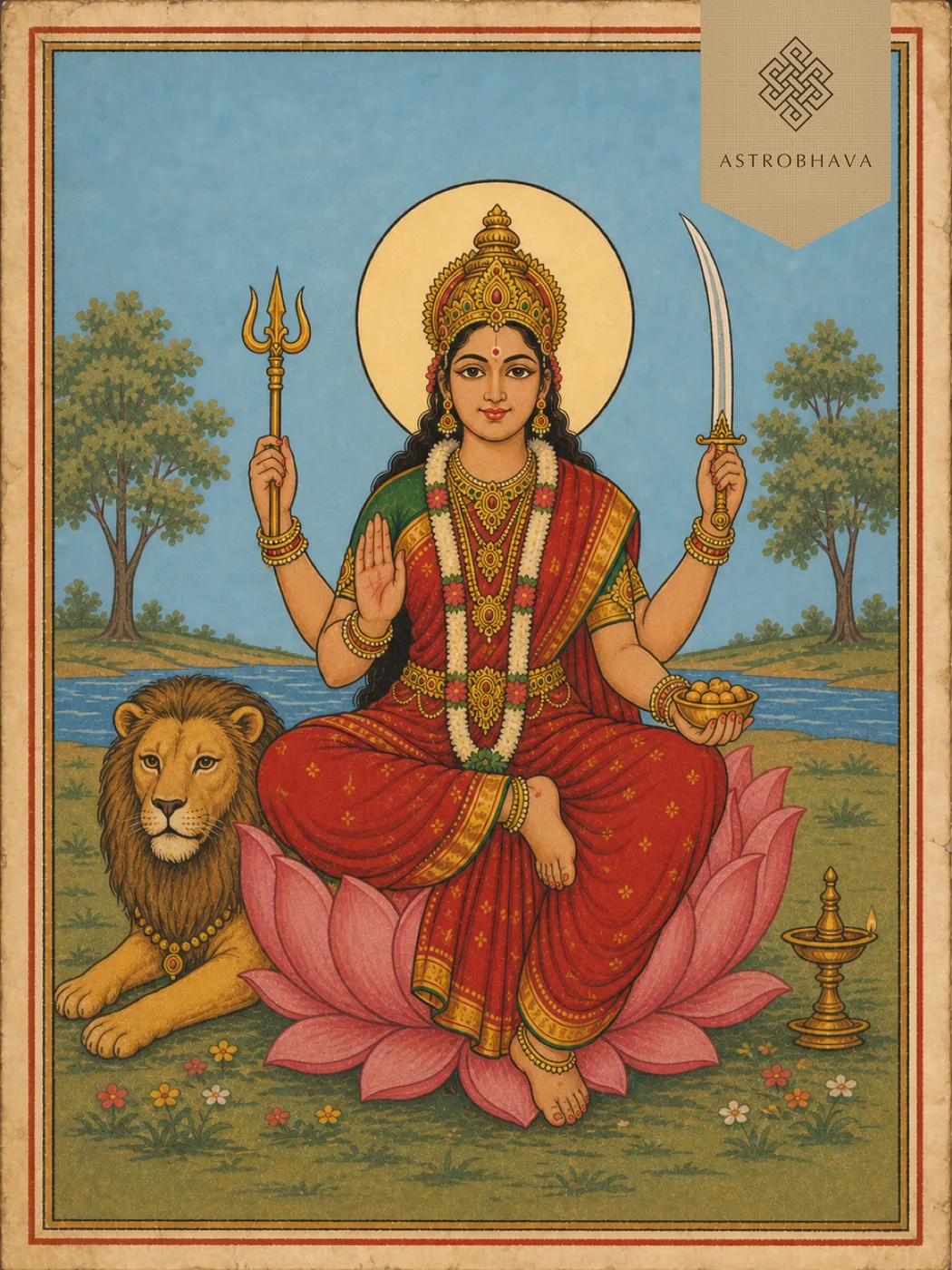
Santoshi Mata Mantra
ॐ श्री सन्तोषी मात्रे नमःIn Devanagari, Tamil, Telugu, Kannada, Malayalam and English — with the meaning of every word, and the one syllable most people pronounce wrongly.
Who Santoshi Mata is
Santoshi Mata is the goddess whose very name means Mother of Contentment, a form of the Divine Mother whose worship rose to wide recognition in northern and western India through household vrata traditions rather than through the older Puranic pantheon. Folk narratives present her as the daughter of Ganesha, born when his sons sought a sister who would embody settled satisfaction rather than restless desire. She is approached as the quiet settler of quarrels within families, the one who receives the simple offering of jaggery and roasted gram. Her iconography shows a serene four-armed figure, often seated, holding a sword, trident, and a bowl of sweets, with one hand raised in blessing. Unlike the great Shakta goddesses of the classical texts, Santoshi Mata’s presence is felt most strongly in the domestic Friday observance that grew around her name.
The Daughter Born of Contentment
According to the oral and printed vrata-katha cycles that circulate with her Friday fast, Ganesha’s two sons, Shubha and Labha, once asked their father why they had no sister. When the gods and sages assembled, they urged Ganesha to create a daughter whose nature would be santosha, contentment itself. From that collective wish Santoshi Mata appeared. The same katha tradition recounts the trials of a poor daughter-in-law who observed the sixteen-Friday vow in Santoshi Mata’s honour, offering only jaggery and chickpeas while enduring the scorn of wealthier co-wives. Each Friday the goddess quietly arranged circumstances so that the young woman’s patience was vindicated and household strife subsided. The narrative does not appear in the major Puranas; it belongs to the vernacular vrata literature that spread through North Indian homes in the twentieth century and was later fixed in popular print and cinema. In that literature Santoshi Mata remains the deity who answers the longing for an end to petty conflict rather than for worldly enlargement.
The mantra, in six scripts
The seed mantra, and the form most devotees chant daily. No initiation is required — it is open to anyone, including a parent chanting for a child.
- ॐ
- oṃ — the sacred syllable
- श्री
- śrī — auspicious, radiant
- सन्तोषी
- santoṣī — she who is contentment
- मात्रे
- mātre — to the mother
- नमः
- namaḥ — homage
The syllable people get wrong
The second syllable of santoṣī carries the retroflex ṣ, a soft “sh” formed with the tongue-tip curled back. Many speakers flatten it to an ordinary dental s, saying “santosi” as if the name contained the Hindi word for satisfaction without the Vedic sibilant. The ṣ must remain distinct; otherwise the name loses the phonetic shape fixed in the vrata texts.
When Santoshi Mata is chanted
Weekday. Friday
Festival. The sixteen consecutive Fridays of the Santoshi Mata Vrat, observed with the offering of jaggery and gram
Questions
Have your chart read before you decide
Chanting is yours to do, and free. But which deity your situation calls for — and whether a mantra alone is the right response — depends on your chart. Sometimes it is; sometimes it is not.
- Over 30 years in the Guru–Sishya Parampara, from the age of five
- He reads every chart himself — 60 minutes, one to one, never delegated
- Charts are read only between sunrise and sunset, following tradition
Related
Chanting is yours to do. Some things are performed for you.
Where a matter carries real weight — an examination that decides a course, a performance, a child whose studies have stalled — devotees sponsor the homa alongside their own practice. Performed for you and any family members you name, at our Yagna Ashram, in your name and gotra, on a muhurta calculated from your chart, and telecast live so you can watch it done for you.