Satyanarayana Mantra
ध्यायेत् सत्यं गुणातीतं गुणत्रयसमन्वितम् । लोकनाथं त्रिलोकेशं कौस्तुभाभरणं हरिम् ॥Also known as Dhyayet Satyam
In Devanagari, Tamil, Telugu, Kannada, Malayalam and English — with the meaning of every word, and the one syllable most people pronounce wrongly.
 The Narayana Sukta Homam, performed for youBook →
What the Satyanarayana Mantra is
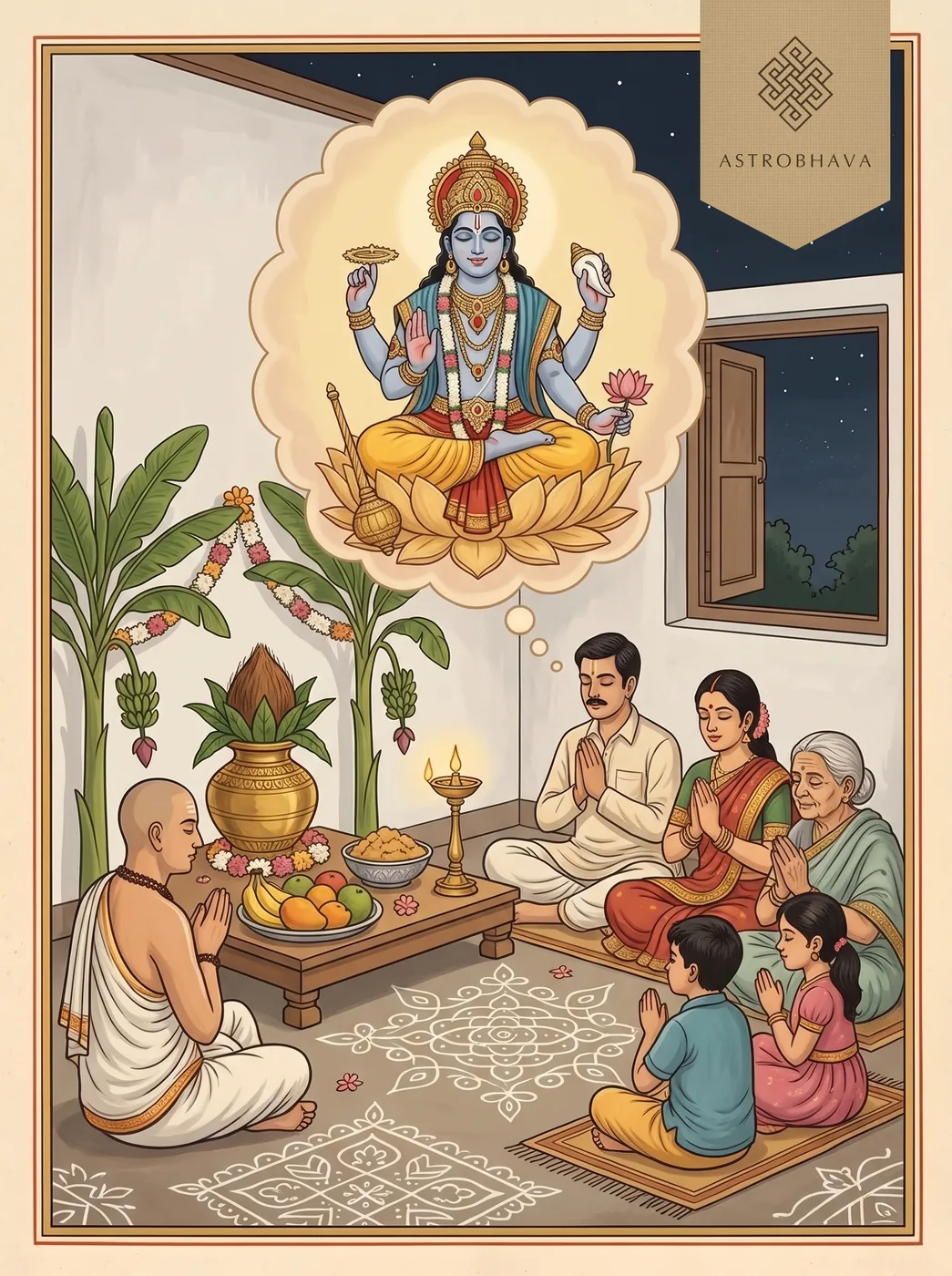
The Satyanarayana Mantra, the Satyanarayan puja mantra of household worship, is not one line but four short items that puja manuals print for this rite, none with a named author. The first two are dhyana verses, opening 'Dhyayet satyam', in which the worshipper pictures the deity before the offerings begin: Satya beyond the three gunas and yet holding all three, blue in colour and robed in yellow, wearing the Kaustubha gem and the Shrivatsa mark, honoured by Brahma and the other gods. The third, Om Namo Bhagavate Vasudevaya, is the twelve-syllable Vishnu mantra, which some modern guides set within this rite while the older manual does not. The fourth, Om Shri Satyanarayanaya Namah, is the working formula of the worship: the manuals repeat it at offering after offering, adding the words for seat, water, flowers, lamp or food. The rite itself has its own page at /puja/sathyanarayana-puja/.
Lines of the manual, not the katha
These lines do not come from the story the rite is known for. The Satyanarayana katha is a narrative in five chapters: Suta tells the sages at Naimisha how Narada, grieved by human suffering, went to Vishnu and was taught the vow, and then how a poor Brahmin of Kashi, a woodcutter, a merchant and his family, and King Tungadhwaja fared by keeping or slighting it. Nowhere in those chapters does anyone speak the dhyana or either mantra. They belong to the priest's order of service that accompanies the reading. In the manuals, after the preliminary worship of Ganesha, the kalasha, the directions and the nine grahas, the heading 'atha dhyanam' brings in the two verses, with the instruction to close the eyes and picture the deity. Only then is the deity invited and the offerings begin. One manual seals the verses with 'iti satyanarayanam dhyayami', thus I meditate on Satyanarayana. The twelve-syllable mantra has an older home: in the Bhagavata Purana (4.8.54), Narada, instructing the boy Dhruva, names it as the mantra for worshipping the deity's image with flowers, fruit and food. Its place in this puja is a custom of some modern guides, which set it at the invocation and the sixteen offerings.
The mantra, in six scripts
- ध्यायेत्
- dhyāyet — one should meditate on
- सत्यं
- satyaṃ — Satya, the Truth
- गुणातीतं
- guṇātītaṃ — beyond the gunas
- गुणत्रयसमन्वितम्
- guṇatrayasamanvitam — possessed of the three gunas
- लोकनाथं
- lokanāthaṃ — master of the world
- त्रिलोकेशं
- trilokeśaṃ — ruler of the three worlds
- कौस्तुभाभरणं
- kaustubhābharaṇaṃ — adorned with the Kaustubha gem
- हरिम्
- harim — Hari
Satyanarayana Mantra lyrics in full
Two dhyana verses followed by two mantras. One manual reads 'pitavasam' for 'pitavastram' in the second verse, with the same meaning.
All 4 verses, in Sanskrit, Tamil, Telugu, Kannada, Malayalam and English, each with its meaning. Choose a script:
Download the Satyanarayana Mantra PDFAll 4 verses with their meanings, in Sanskrit. Free to print and keep.
ध्यायेत् सत्यं गुणातीतं गुणत्रयसमन्वितम् ।
लोकनाथं त्रिलोकेशं कौस्तुभाभरणं हरिम् ॥
த்யாயேத் ஸத்யம் குணாதீதம் குணத்ரயஸமந்விதம் ।
லோகநாதம் த்ரிலோகேஶம் கௌஸ்துபாபரணம் ஹரிம் ॥
ధ్యాయేత్ సత్యం గుణాతీతం గుణత్రయసమన్వితమ్ ।
లోకనాథం త్రిలోకేశం కౌస్తుభాభరణం హరిమ్ ॥
ಧ್ಯಾಯೇತ್ ಸತ್ಯಂ ಗುಣಾತೀತಂ ಗುಣತ್ರಯಸಮನ್ವಿತಮ್ ।
ಲೋಕನಾಥಂ ತ್ರಿಲೋಕೇಶಂ ಕೌಸ್ತುಭಾಭರಣಂ ಹರಿಮ್ ॥
ധ്യായേത് സത്യം ഗുണാതീതം ഗുണത്രയസമന്വിതമ് ।
ലോകനാഥം ത്രിലോകേശം കൌസ്തുഭാഭരണം ഹരിമ് ॥
dhyāyet satyaṃ guṇātītaṃ guṇatrayasamanvitam |
lokanāthaṃ trilokeśaṃ kaustubhābharaṇaṃ harim ||
One should meditate on Satya, the Truth, who is beyond the three gunas and yet possessed of all three: Hari, lord of the world, ruler of the three worlds, adorned with the Kaustubha gem.
नीलवर्णं पीतवस्त्रं श्रीवत्सपदभूषितम् ।
गोविन्दं गोकुलानन्दं ब्रह्माद्यैरपि पूजितम् ॥
நீலவர்ணம் பீதவஸ்த்ரம் ஶ்ரீவத்ஸபதபூஷிதம் ।
கோவிந்தம் கோகுலாநந்தம் ப்ரஹ்மாத்யைரபி பூஜிதம் ॥
నీలవర్ణం పీతవస్త్రం శ్రీవత్సపదభూషితమ్ ।
గోవిన్దం గోకులానన్దం బ్రహ్మాద్యైరపి పూజితమ్ ॥
ನೀಲವರ್ಣಂ ಪೀತವಸ್ತ್ರಂ ಶ್ರೀವತ್ಸಪದಭೂಷಿತಮ್ ।
ಗೋವಿನ್ದಂ ಗೋಕುಲಾನನ್ದಂ ಬ್ರಹ್ಮಾದ್ಯೈರಪಿ ಪೂಜಿತಮ್ ॥
നീലവര്ണം പീതവസ്ത്രം ശ്രീവത്സപദഭൂഷിതമ് ।
ഗോവിന്ദം ഗോകുലാനന്ദം ബ്രഹ്മാദ്യൈരപി പൂജിതമ് ॥
nīlavarṇaṃ pītavastraṃ śrīvatsapadabhūṣitam |
govindaṃ gokulānandaṃ brahmādyairapi pūjitam ||
He is blue in color and clothed in yellow, adorned with the Shrivatsa mark. He is Govinda, the joy of Gokula, worshipped even by Brahma and the other gods.
ॐ नमो भगवते वासुदेवाय ॥
ௐ நமோ பகவதே வாஸுதேவாய ॥
ఓం నమో భగవతే వాసుదేవాయ ॥
ಓಂ ನಮೋ ಭಗವತೇ ವಾಸುದೇವಾಯ ॥
ഓം നമോ ഭഗവതേ വാസുദേവായ ॥
oṃ namo bhagavate vāsudevāya ||
Om, salutations to the Lord Vasudeva.
ॐ श्रीसत्यनारायणाय नमः ॥
ௐ ஶ்ரீஸத்யநாராயணாய நமஃ ॥
ఓం శ్రీసత్యనారాయణాయ నమః ॥
ಓಂ ಶ್ರೀಸತ್ಯನಾರಾಯಣಾಯ ನಮಃ ॥
ഓം ശ്രീസത്യനാരായണായ നമഃ ॥
oṃ śrīsatyanārāyaṇāya namaḥ ||
Om, salutations to Shri Satyanarayana.
The syllable people get wrong
In guṇātītaṃ the word is guṇa plus atīta joined, so the second syllable is a long ā and the third a long ī: goo-naa-TEE-tum. The hurried 'guna-titam' loses the join that gives the word its sense of going beyond the gunas.
When the Satyanarayana Mantra is chanted
Weekday. Thursday
Festival. Purnima Satyanarayan vrat
Questions
Have your chart read before you decide
Chanting is yours to do, and free. But which deity your situation calls for — and whether a mantra alone is the right response — depends on your chart. Sometimes it is; sometimes it is not.
- Over 30 years in the Guru–Sishya Parampara, from the age of five
- He reads every chart himself — 60 minutes, one to one, never delegated
- Charts are read only between sunrise and sunset, following tradition
