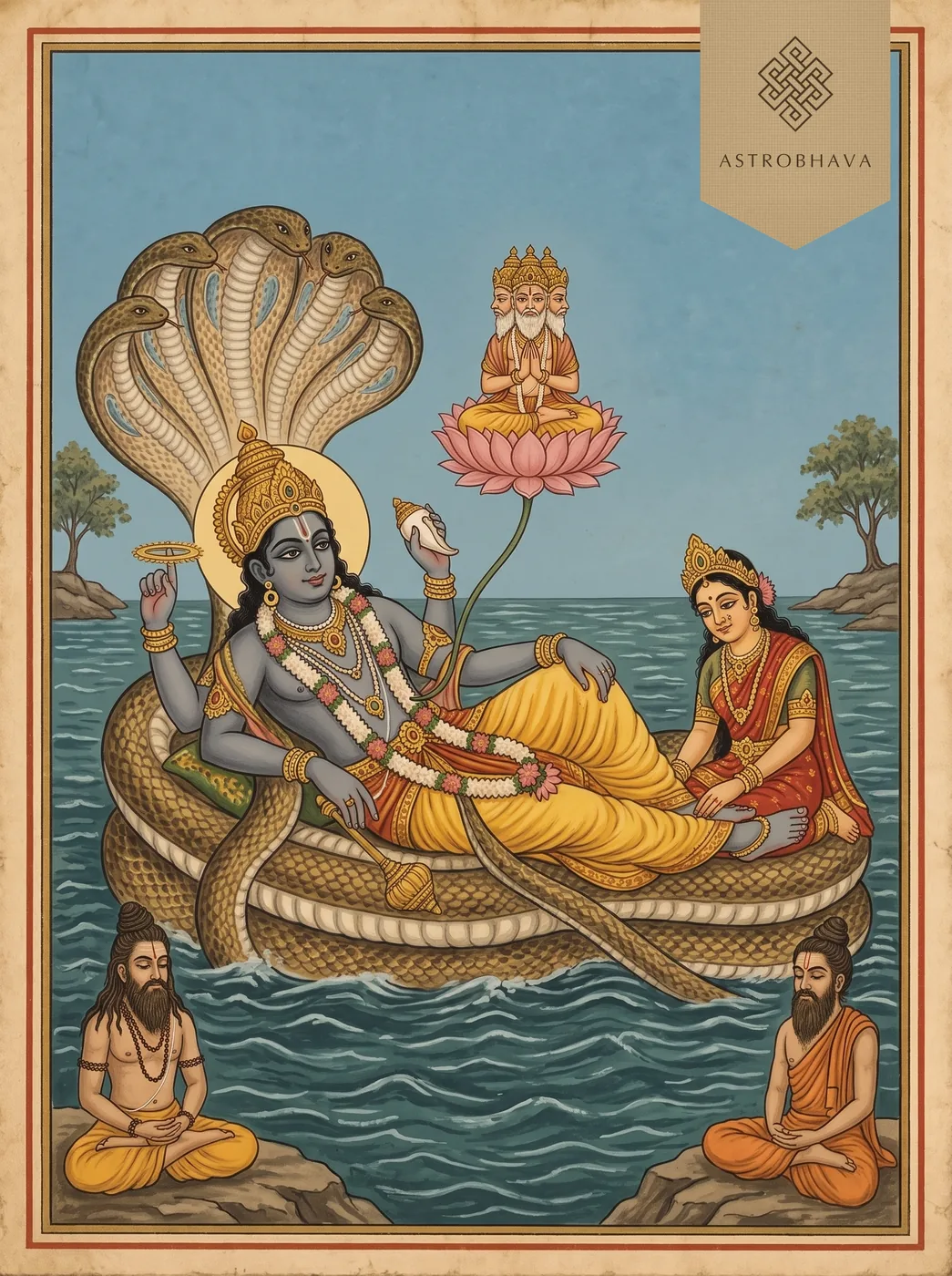
Shantakaram Bhujagashayanam
शान्ताकारं भुजगशयनं पद्मनाभं सुरेशं विश्वाधारं गगनसदृशं मेघवर्णं शुभाङ्गम् । लक्ष्मीकान्तं कमलनयनं योगिभिर्ध्यानगम्यं वन्दे विष्णुं भवभयहरं सर्वलोकैकनाथम् ॥Also known as Vishnu Dhyana Shloka
In Devanagari, Tamil, Telugu, Kannada, Malayalam and English — with the meaning of every word, and the one syllable most people pronounce wrongly.
 The Lakshmi Narayana Homa, performed for youBook →
What the Shantakaram Bhujagashayanam is
Shantakaram Bhujagashayanam, the Vishnu dhyana shloka that begins 'shantakaram bhujagashayanam padmanabham suresham', is a single Sanskrit verse for holding one image of Vishnu in the mind before worship. No printing names an author. It belongs to the dhyanam, the group of meditation verses that prayer books set before the Vishnu Sahasranama, and it is also learned on its own as a daily prayer. Grammatically the whole verse hangs on one verb, vande, 'I bow', with thirteen descriptions gathered around the name Vishnu. The first half paints the reclining Lord: peaceful in form, lying on the serpent, the lotus rising from his navel, vast as the sky and the colour of a rain cloud. The second half turns to relationship and refuge: Lakshmi's beloved, lotus-eyed, reached by yogis in meditation, the one who removes the fear of worldly existence. Printed with it here is the Meghashyamam verse that follows it in Sahasranama books and closes on the same refrain, sarvalokaikanatham.
The third meditation before the thousand names
The thousand names of Vishnu come from the Anushasana Parva of the Mahabharata, but the way they are recited carries a longer frame. After the opening verses to Vishnu and to Vyasa, the dialogue between Yudhishthira and Bhishma, and the nyasa that names the hymn's seer, metre and deity, the book announces 'atha dhyanam', 'now the meditation'. In Swami Krishnananda's edition three pictures follow in turn. The first seats Mukunda on a pearl-strewn shore of the ocean of milk beneath clouds raining nectar. The second sees the universe as his body, the earth his feet and the sky his navel. Shantakaram comes third and lays him at rest on the serpent; the Meghashyamam verse then shows him adorned in yellow silk with the Kaustubha jewel on his chest. The reclining picture is the form worshipped at the Padmanabhaswamy Temple in Thiruvananthapuram, where the Lord lies on Adi Shesha and Brahma rises on a lotus from his navel, and the verse's own word padmanabha is the temple's name for him. The verse is composed in mandakranta, the 'slow-stepping' metre of seventeen syllables to a line that Kalidasa chose for the Meghaduta, his poem of a messenger cloud; its companion verse is in the shorter shalini metre.
The mantra, in six scripts
- शान्ताकारं
- śāntākāraṃ — whose form is peace
- भुजगशयनं
- bhujagaśayanaṃ — lying on the serpent
- पद्मनाभं
- padmanābhaṃ — lotus-naveled
- सुरेशं
- sureśaṃ — lord of the gods
- विश्वाधारं
- viśvādhāraṃ — support of the universe
- गगनसदृशं
- gaganasadṛśaṃ — like the sky
- मेघवर्णं
- meghavarṇaṃ — rain-cloud coloured
- शुभाङ्गम्
- śubhāṅgam — of auspicious limbs
- लक्ष्मीकान्तं
- lakṣmīkāntaṃ — Lakshmi's beloved
- कमलनयनं
- kamalanayanaṃ — lotus-eyed
- योगिभिर्ध्यानगम्यं
- yogibhirdhyānagamyaṃ — reached by yogis in meditation
- वन्दे
- vande — I bow to
- विष्णुं
- viṣṇuṃ — Vishnu
- भवभयहरं
- bhavabhayaharaṃ — remover of the fear of worldly existence
- सर्वलोकैकनाथम्
- sarvalokaikanātham — sole lord of all worlds
Shantakaram Bhujagashayanam lyrics in full
The Shantakaram verse with the Meghashyamam verse that follows it in Vishnu Sahasranama prayer books.
All 2 verses, in Sanskrit, Tamil, Telugu, Kannada, Malayalam and English, each with its meaning. Choose a script:
Download the Shantakaram Bhujagashayanam PDFAll 2 verses with their meanings, in Sanskrit. Free to print and keep.
शान्ताकारं भुजगशयनं पद्मनाभं सुरेशं विश्वाधारं गगनसदृशं मेघवर्णं शुभाङ्गम् ।
लक्ष्मीकान्तं कमलनयनं योगिभिर्ध्यानगम्यं वन्दे विष्णुं भवभयहरं सर्वलोकैकनाथम् ॥
ஶாந்தாகாரம் புஜகஶயநம் பத்மநாபம் ஸுரேஶம் விஶ்வாதாரம் ககநஸத்ருஶம் மேகவர்ணம் ஶுபாங்கம் ।
லக்ஷ்மீகாந்தம் கமலநயநம் யோகிபிர்த்யாநகம்யம் வந்தே விஷ்ணும் பவபயஹரம் ஸர்வலோகைகநாதம் ॥
శాన్తాకారం భుజగశయనం పద్మనాభం సురేశం విశ్వాధారం గగనసదృశం మేఘవర్ణం శుభాఙ్గమ్ ।
లక్ష్మీకాన్తం కమలనయనం యోగిభిర్ధ్యానగమ్యం వన్దే విష్ణుం భవభయహరం సర్వలోకైకనాథమ్ ॥
ಶಾನ್ತಾಕಾರಂ ಭುಜಗಶಯನಂ ಪದ್ಮನಾಭಂ ಸುರೇಶಂ ವಿಶ್ವಾಧಾರಂ ಗಗನಸದೃಶಂ ಮೇಘವರ್ಣಂ ಶುಭಾಙ್ಗಮ್ ।
ಲಕ್ಷ್ಮೀಕಾನ್ತಂ ಕಮಲನಯನಂ ಯೋಗಿಭಿರ್ಧ್ಯಾನಗಮ್ಯಂ ವನ್ದೇ ವಿಷ್ಣುಂ ಭವಭಯಹರಂ ಸರ್ವಲೋಕೈಕನಾಥಮ್ ॥
ശാന്താകാരം ഭുജഗശയനം പദ്മനാഭം സുരേശം വിശ്വാധാരം ഗഗനസദൃശം മേഘവര്ണം ശുഭാങ്ഗമ് ।
ലക്ഷ്മീകാന്തം കമലനയനം യോഗിഭിര്ധ്യാനഗമ്യം വന്ദേ വിഷ്ണും ഭവഭയഹരം സര്വലോകൈകനാഥമ് ॥
śāntākāraṃ bhujagaśayanaṃ padmanābhaṃ sureśaṃ viśvādhāraṃ gaganasadṛśaṃ meghavarṇaṃ śubhāṅgam |
lakṣmīkāntaṃ kamalanayanaṃ yogibhirdhyānagamyaṃ vande viṣṇuṃ bhavabhayaharaṃ sarvalokaikanātham ||
I bow to Vishnu, whose form is peace, who rests on the serpent, from whose navel grows the lotus, the lord of the gods, the support of the universe, boundless like the sky, the colour of a rain cloud, with auspicious limbs. He is the beloved of Lakshmi, lotus-eyed, reached by yogis through meditation, the remover of the fear of worldly existence, the one lord of all the worlds.
मेघश्यामं पीतकौशेयवासं श्रीवत्साङ्कं कौस्तुभोद्भासिताङ्गम् ।
पुण्योपेतं पुण्डरीकायताक्षं विष्णुं वन्दे सर्वलोकैकनाथम् ॥
மேகஶ்யாமம் பீதகௌஶேயவாஸம் ஶ்ரீவத்ஸாங்கம் கௌஸ்துபோத்பாஸிதாங்கம் ।
புண்யோபேதம் புண்டரீகாயதாக்ஷம் விஷ்ணும் வந்தே ஸர்வலோகைகநாதம் ॥
మేఘశ్యామం పీతకౌశేయవాసం శ్రీవత్సాఙ్కం కౌస్తుభోద్భాసితాఙ్గమ్ ।
పుణ్యోపేతం పుణ్డరీకాయతాక్షం విష్ణుం వన్దే సర్వలోకైకనాథమ్ ॥
ಮೇಘಶ್ಯಾಮಂ ಪೀತಕೌಶೇಯವಾಸಂ ಶ್ರೀವತ್ಸಾಙ್ಕಂ ಕೌಸ್ತುಭೋದ್ಭಾಸಿತಾಙ್ಗಮ್ ।
ಪುಣ್ಯೋಪೇತಂ ಪುಣ್ಡರೀಕಾಯತಾಕ್ಷಂ ವಿಷ್ಣುಂ ವನ್ದೇ ಸರ್ವಲೋಕೈಕನಾಥಮ್ ॥
മേഘശ്യാമം പീതകൌശേയവാസം ശ്രീവത്സാങ്കം കൌസ്തുഭോദ്ഭാസിതാങ്ഗമ് ।
പുണ്യോപേതം പുണ്ഡരീകായതാക്ഷം വിഷ്ണും വന്ദേ സര്വലോകൈകനാഥമ് ॥
meghaśyāmaṃ pītakauśeyavāsaṃ śrīvatsāṅkaṃ kaustubhodbhāsitāṅgam |
puṇyopetaṃ puṇḍarīkāyatākṣaṃ viṣṇuṃ vande sarvalokaikanātham ||
I bow to Vishnu, the one lord of all the worlds, dark as a rain cloud and clothed in yellow silk, marked with the Shrivatsa, his body shining with the Kaustubha gem. He is full of holiness, with long eyes like the white lotus.
The syllable people get wrong
The second word is bhujagaśayanaṃ, with bhujaga, not bhujaṅga; both mean serpent, and many sing 'bhujanga-shayanam', but the metre needs five light syllables in a row here, so say it with no nasal: bhu-ja-ga-sha-ya-nam.
When the Shantakaram Bhujagashayanam is chanted
Weekday. Thursday
Questions
Have your chart read before you decide
Chanting is yours to do, and free. But which deity your situation calls for — and whether a mantra alone is the right response — depends on your chart. Sometimes it is; sometimes it is not.
- Over 30 years in the Guru–Sishya Parampara, from the age of five
- He reads every chart himself — 60 minutes, one to one, never delegated
- Charts are read only between sunrise and sunset, following tradition
