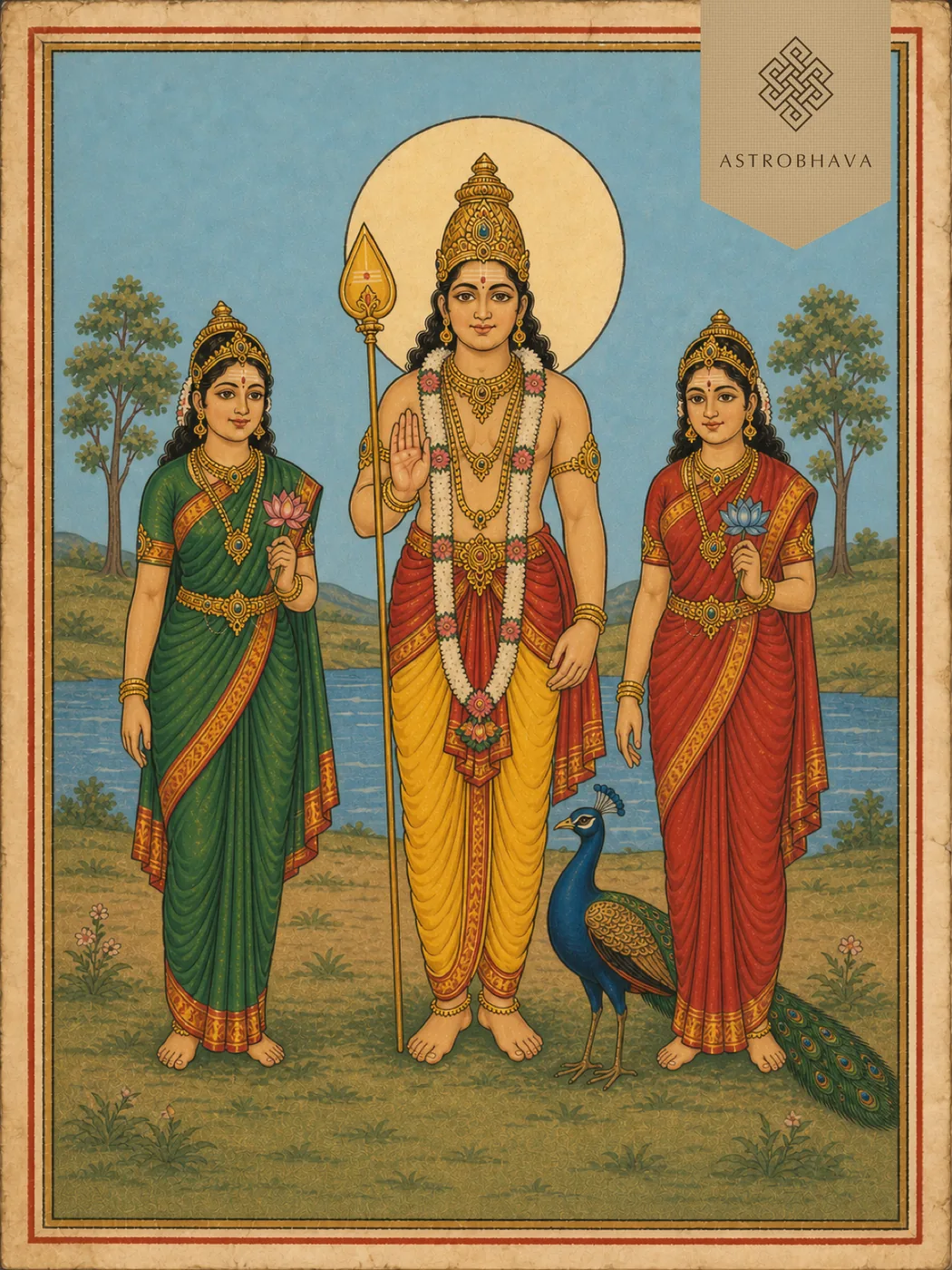
Valli Devasena Sametha Mantra
ॐ वल्लीदेवसेनासमेतसुब्रह्मण्याय नमःIn Devanagari, Tamil, Telugu, Kannada, Malayalam and English — with the meaning of every word, and the one syllable most people pronounce wrongly.
Who Valli Devasena Sametha is
Valli Devasena Sametha Subrahmanya is the same six-faced lord when he is contemplated in the company of his two consorts, the forest-born Valli and the celestial Devasena. Valli is the daughter of a hunter-chieftain of the Kurava tribe, discovered among the millet fields of the southern hills; Devasena is the daughter of Indra, given in marriage after the victory over Taraka. Together the three form a single iconographic unit found in the sanctums of Tiruttani, Sivanmalai and other Murugan temples, where the god stands between the two goddesses, the Vel held lightly and the peacock at rest. The triad expresses the union of the wild mountain and the ordered heaven within the person of the commander, a configuration that belongs only to this deity and to no other divine household.
Two brides of the hill
The Kandapuranam, the Tamil rendering of the Skanda cycle, narrates that after the defeat of Surapadman the gods offered Devasena, Indra’s daughter, to the young general as bride. The marriage was celebrated in the heavenly court with full Vedic rites. Yet Subrahmanya’s heart also turned toward the hills. There, in the country of the hunters, a girl named Valli had been born from a doe that drank the semen of a rishi; she grew up guarding the millet crop. Disguised first as a hunter and then as an old ascetic, the god wooed her with the help of his brother Ganesha, who appeared as a wild elephant to frighten her into the ascetic’s arms. Their union was solemnised beneath the venkai tree. Thereafter the two wives stand on either side of him: Devasena on the right as the legitimate celestial spouse, Valli on the left as the beloved of the mountain. The double marriage is recorded only in the southern tradition surrounding Murugan and is never ascribed to any other god.
The mantra, in six scripts
The seed mantra, and the form most devotees chant daily. No initiation is required — it is open to anyone, including a parent chanting for a child.
- ॐ
- oṃ — the primordial syllable
- वल्लीदेवसेनासमेतसुब्रह्मण्याय
- vallīdevasenāsametasubrahmaṇyāya — to Subrahmanya accompanied by Valli and Devasena
- नमः
- namaḥ — salutation
The syllable people get wrong
The long ī of vallī is commonly shortened to a brief i, yielding the incorrect va-lli. The syllable must be held as a full long vowel before the soft d of deva, otherwise the name of the hunter-maiden is reduced and the mantra no longer distinguishes her from any other consort.
When Valli Devasena Sametha is chanted
Weekday. Tuesday
Festival. Panguni Uthiram
Questions
Have your chart read before you decide
Chanting is yours to do, and free. But which deity your situation calls for — and whether a mantra alone is the right response — depends on your chart. Sometimes it is; sometimes it is not.
- Over 30 years in the Guru–Sishya Parampara, from the age of five
- He reads every chart himself — 60 minutes, one to one, never delegated
- Charts are read only between sunrise and sunset, following tradition
Related
Chanting is yours to do. Some things are performed for you.
Where a matter carries real weight — an examination that decides a course, a performance, a child whose studies have stalled — devotees sponsor the homa alongside their own practice. Performed for you and any family members you name, at our Yagna Ashram, in your name and gotra, on a muhurta calculated from your chart, and telecast live so you can watch it done for you.