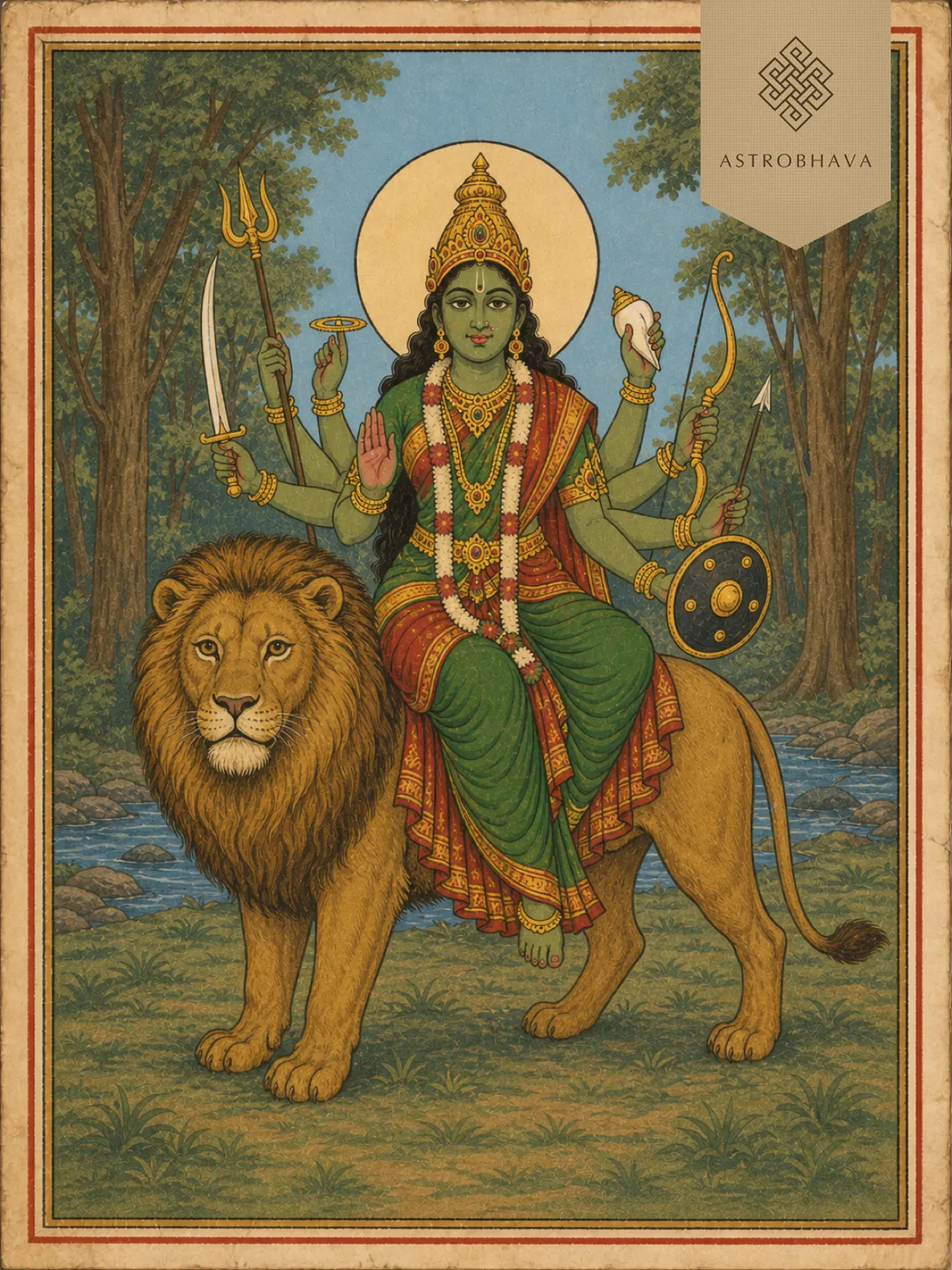
Vana Durga Mantra
ॐ दुं वनदुर्गायै नमःIn Devanagari, Tamil, Telugu, Kannada, Malayalam and English — with the meaning of every word, and the one syllable most people pronounce wrongly.
Who Vana Durga is
Vana Durga is the forest-dwelling face of the goddess, the one whose proper realm is the uncultivated margin rather than the fortified temple or the royal court. She is remembered in tantric and folk strands as the protector of those who must move through wilderness—pilgrims, herdsmen, and travellers whose path leaves the safety of settled ground. Her name joins vana, the forest, to Durga, signalling that the inaccessible fortress can also be a grove, a thicket, or the deep shade where ordinary landmarks disappear. In certain lists of the nine Durgas she occupies the place of the wild, unbound shakti who does not require brick walls or consecrated flags. Offerings to her traditionally include leaves, wild flowers, and the acknowledgment that the forest itself is her body. She remains fierce, yet her fierceness is that of the untamed rather than of the battlefield.
The Grove That Sheltered
A strand preserved in the Devi Bhagavata and elaborated in regional forest-shrine legends tells that when the gods fled an asura onslaught they took refuge in a remote woodland. There the goddess appeared not on a lion amid celestial armies but as a presence already resident among the trees. She instructed the fugitives to remain within the grove’s boundary and declared that the forest itself would become the fortress. The asura’s forces, entering the trees, lost their way; roots tangled their feet and branches turned their weapons aside. In the stillness of that green enclosure the goddess revealed herself as Vana Durga, the Durga whose inaccessibility is the density of the wild rather than the height of a rampart. The episode is cited in the foundation stories of several forest temples in the Eastern Ghats and the Western coastal ranges, where the deity is still approached as the one who keeps the path open for those who must travel beyond the village edge.
The mantra, in six scripts
The seed mantra, and the form most devotees chant daily. No initiation is required — it is open to anyone, including a parent chanting for a child.
- ॐ
- oṃ — the primal syllable
- दुं
- duṃ — seed-syllable of Durga
- वनदुर्गायै
- vanadurgāyai — to Durga of the forest
- नमः
- namaḥ — salutation
The syllable people get wrong
The opening va of vanadurgāyai is repeatedly pronounced as an English “w,” rounding the lips instead of letting the upper teeth meet the lower lip in the light Sanskrit labio-dental. A second habitual error lengthens the short first a of vana into “vaana,” shifting the stress and turning the crisp forest-name into a drawn-out syllable the metre of the mantra does not carry.
When Vana Durga is chanted
Weekday. Friday
Questions
Have your chart read before you decide
Chanting is yours to do, and free. But which deity your situation calls for — and whether a mantra alone is the right response — depends on your chart. Sometimes it is; sometimes it is not.
- Over 30 years in the Guru–Sishya Parampara, from the age of five
- He reads every chart himself — 60 minutes, one to one, never delegated
- Charts are read only between sunrise and sunset, following tradition
Related
Chanting is yours to do. Some things are performed for you.
Where a matter carries real weight — an examination that decides a course, a performance, a child whose studies have stalled — devotees sponsor the homa alongside their own practice. Performed for you and any family members you name, at our Yagna Ashram, in your name and gotra, on a muhurta calculated from your chart, and telecast live so you can watch it done for you.