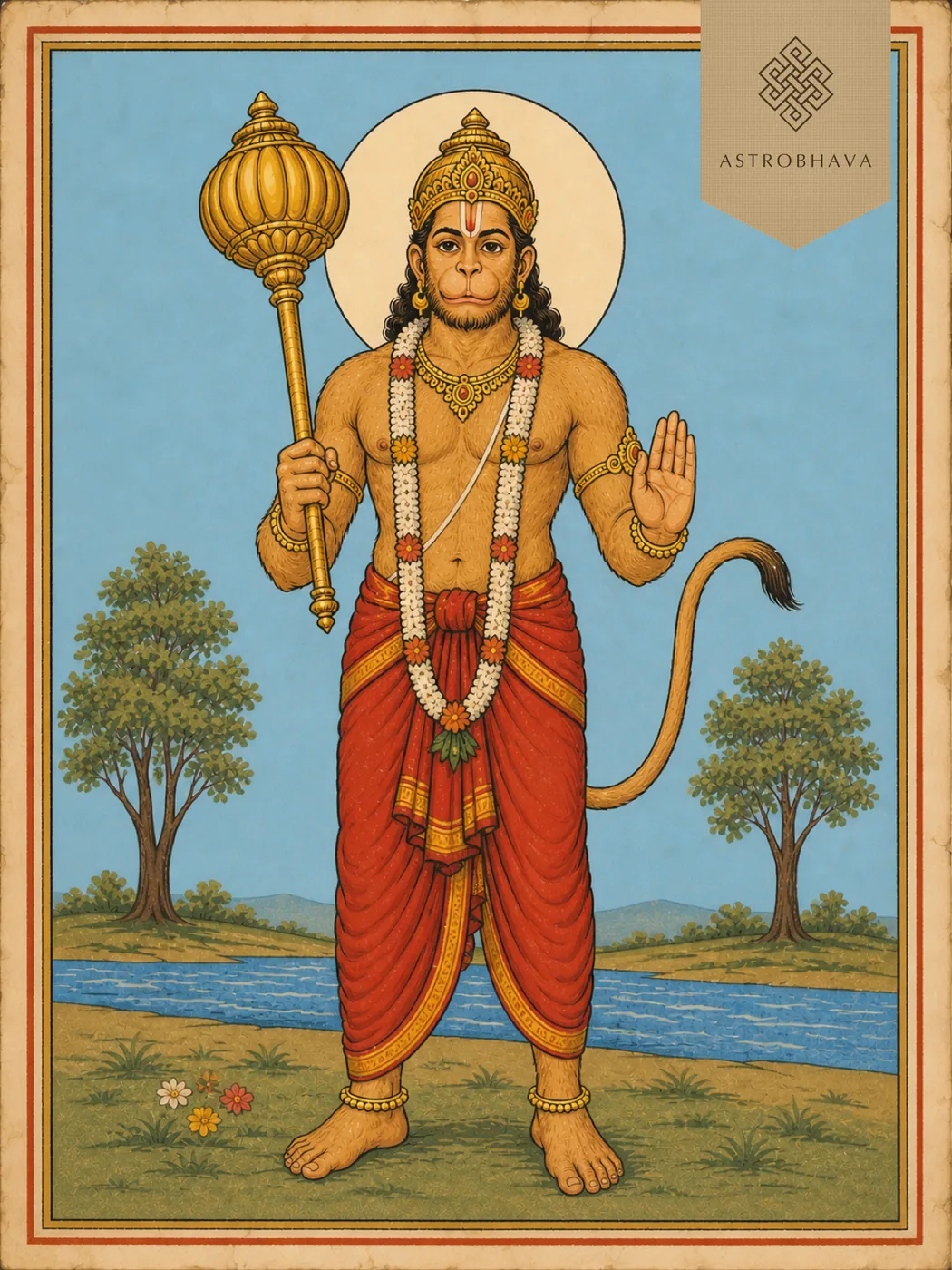
Veera Hanuman Mantra
ॐ वीर हनुमते नमःIn Devanagari, Tamil, Telugu, Kannada, Malayalam and English — with the meaning of every word, and the one syllable most people pronounce wrongly.
Who Veera Hanuman is
Veera Hanuman is the martial aspect of the son of the wind-god, the form in which Hanuman stands fully prepared for combat rather than seated in quiet devotion. Temple sculpture and processional images show him with mace raised, jaw set, and sometimes with multiple arms, an iconography that marks the shift from messenger to general of the vanara host. Valmiki’s Ramayana and the regional retellings in Tamil, Telugu, and Kannada present this figure as the one who crosses the ocean already armed for confrontation, who burns the capital of Lanka, and who later duels the rakshasa champions on the field before Lanka’s gates. In fortress towns and boundary shrines across the peninsula he is installed specifically as Veera Hanuman, the active power that meets opposition in open encounter. He is not a separate god from Hanuman but the same deity when the narrative turns from service to battle.
The Fire in Lanka
In the Sundara Kanda of Valmiki’s Ramayana, Hanuman locates Sita in the ashoka grove and then allows capture so that Rama’s name may be spoken directly in Ravana’s court. Bound before the demon king, he declares himself the servant of Rama and warns of the ruin that will follow refusal. Ravana orders the monkey’s tail wrapped in oil-soaked cloth and set alight as public humiliation. The instant the fire catches, Hanuman shrinks from his bonds, then swells again to heroic size. With the burning tail as his weapon he races the rooftops and towers of Lanka, carrying flame from the outer ramparts into the inner apartments until the city itself becomes the pyre. Only the grove where Sita remains is left untouched. The episode fixes Veera Hanuman as the warrior who converts an instrument of mockery into the means of a capital’s downfall, acting alone inside the enemy stronghold before the larger war begins. Kamban’s Tamil Ramavataram and the Telugu Ranganatha Ramayanam retain the same sequence, lingering on the path of the fire through named streets and palaces.
The mantra, in six scripts
The seed mantra, and the form most devotees chant daily. No initiation is required — it is open to anyone, including a parent chanting for a child.
- ॐ
- oṃ — the sacred syllable
- वीर
- vīra — warrior, heroic
- हनुमते
- hanumate — to Hanuman
- नमः
- namaḥ — salutation
The syllable people get wrong
The long ī inside vīra is the syllable that slips. Speakers commonly shorten it to a brief i, producing “vira” instead of the sustained vī-ra the metre and the name require. The vowel must be held full length before the tongue releases into the flap of ra.
When Veera Hanuman is chanted
Weekday. Tuesday
Festival. Hanuman Jayanti
Questions
Have your chart read before you decide
Chanting is yours to do, and free. But which deity your situation calls for — and whether a mantra alone is the right response — depends on your chart. Sometimes it is; sometimes it is not.
- Over 30 years in the Guru–Sishya Parampara, from the age of five
- He reads every chart himself — 60 minutes, one to one, never delegated
- Charts are read only between sunrise and sunset, following tradition
Related
Chanting is yours to do. Some things are performed for you.
Where a matter carries real weight — an examination that decides a course, a performance, a child whose studies have stalled — devotees sponsor the homa alongside their own practice. Performed for you and any family members you name, at our Yagna Ashram, in your name and gotra, on a muhurta calculated from your chart, and telecast live so you can watch it done for you.