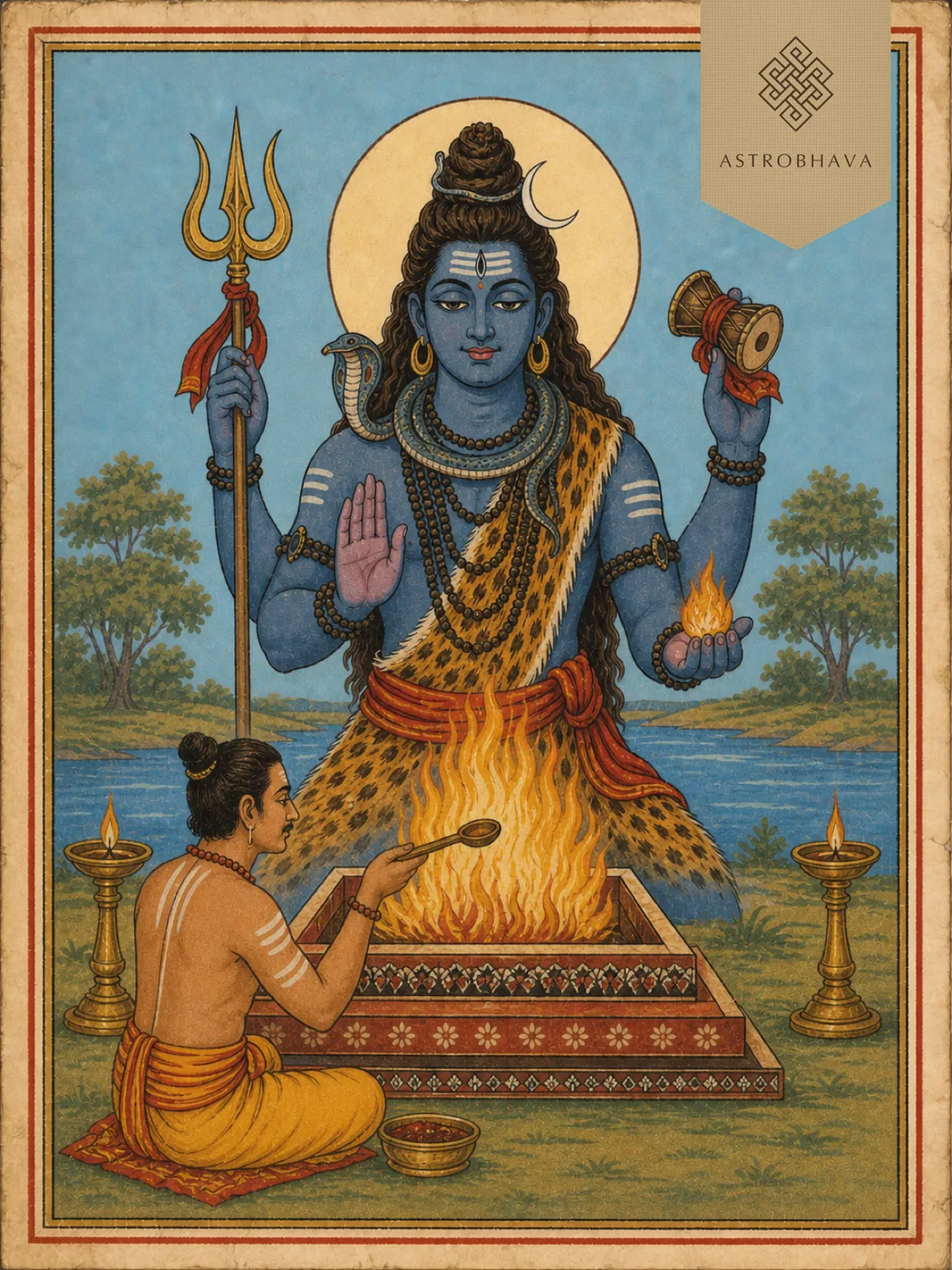
Rudra Homa
Laghu Rudra · Ekadashani Rudra · Maha Rudram · Athi Rudra Maha Homa
श्री रुद्र होमम्The Sri Rudram, chanted into consecrated fire. One rite at four scales — and the only thing that changes between them is how many complete rounds of the Rudram are chanted, from eleven in an afternoon to fourteen thousand six hundred and forty-one across eleven days.
Four scales — free energised Rudra Yantra sealed in a silver amulet with every one, free worldwide delivery, nothing added at checkout.
- Never a group ceremony, at any scale — only the names you give are spoken
- Every day opens and closes with Rudrabhishekam
- Free energised Rudra Yantra, sealed in a silver amulet, shipped worldwide at no charge
Why the Rudra rites matter
A homa is not a prayer beside a fire. It is prayer through fire.
The Sri Rudram is the oldest and most important hymn to Shiva in the Vedas — eleven anuvakas from the Yajur Veda that name Rudra in every aspect at once: the terrible and the auspicious, the destroyer and the healer, the one in the storm and the one in the medicinal herb. The Mahamrityunjaya mantra, the conquering of death, is drawn from it.
What distinguishes the Rudra rites is not the text but the count. Every scale on this page chants the same eleven anuvakas; what changes is how many times. Eleven rounds is the Laghu Rudra, an afternoon. Fourteen thousand six hundred and forty-one, at eleven fire altars over eleven days, is the Athi Rudra — the largest rite we perform, and one that a family or an institution undertakes once.
नमस्ते रुद्र मन्यव उतो त इषवे नमः — "Salutations to your anger, O Rudra, and to your arrow." (Sri Rudram, first anuvaka)How a Rudra rite is built
Six words do all the work on this page. Once they are clear, every scale is the same shape repeated a different number of times.
- Rudram
- The Sri Rudram, or Namakam — eleven anuvakas from the Yajur Veda. One complete recitation is one round.
- Chamakam
- The counterpart hymn. Rudram propitiates; Chamakam then asks. It follows the Rudram at periodic intervals, never woven through it.
- Nyasam
- The placement of the mantra in the body, completed before any recitation may begin. Laghunyasam is the short form; Mahanyasam is the full one.
- Rudrabhishekam
- The ritual bathing of the Shiva lingam. Opens and closes every day of every scale — the recitation is held between two of them.
- Kalasam
- A consecrated pot into which Rudra is invoked, and from which the abhisheka is poured. One in the Laghu Rudra; twelve in every larger scale.
- Vasordhara
- An unbroken stream of ghee poured into the fire, closing the two multi-day rites — the Maha Rudram and the Athi Rudra.
One day of a Rudra rite, start to finish
Rudrabhishekam
The abhisheka opens the day.
Nyasam
Laghunyasam, or the full Mahanyasam in every scale above the Laghu Rudra.
Rudram → Chamakam
One complete round. This is what gets counted, and it is the only thing that changes between the four scales.
Rudrabhishekam
The abhisheka closes the day, exactly as it opened.
In the single-day scales that sequence runs once. In the Maha Rudram it runs on each of six days, and in the Athi Rudra on each of eleven — with the Vasordhara Homa added before the very last abhisheka.
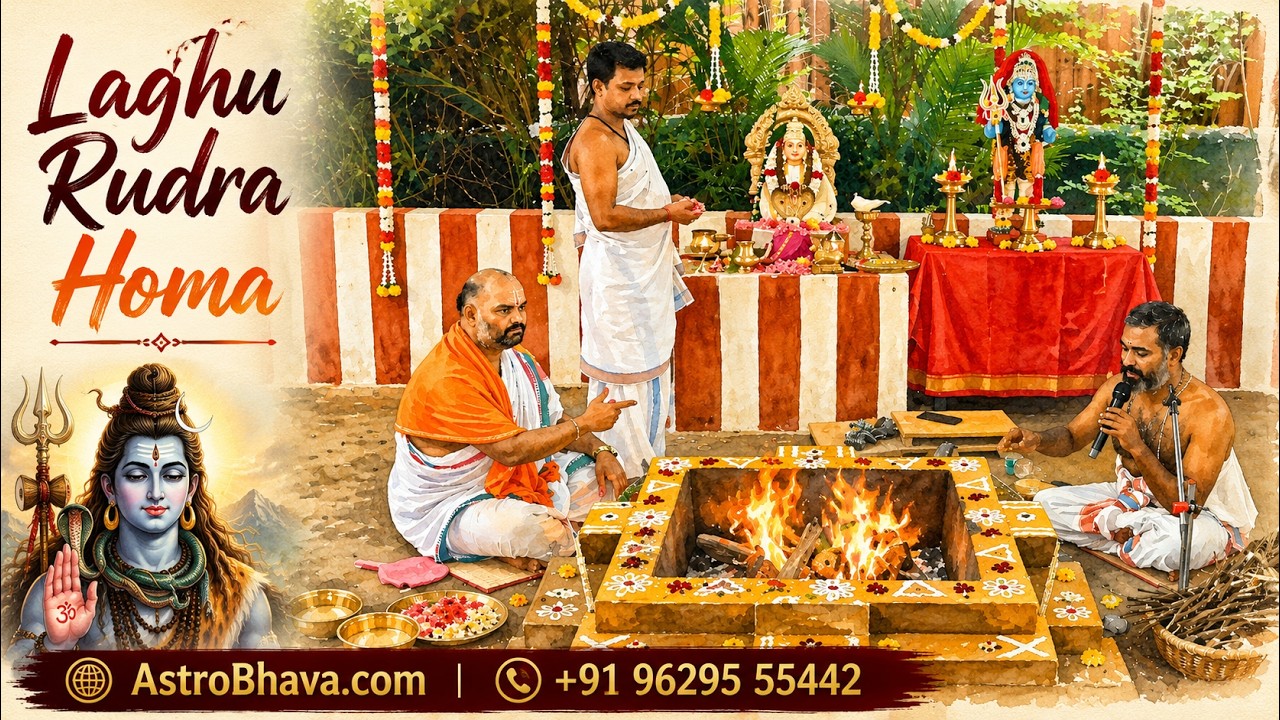
Laghu Rudra Homa
11 Rounds of Rudram4 priests · one day · 3 hours
1 kalasam · Laghunyasam
Ekadashani Rudra Homa
132 Rounds of Rudram11 priests · one day · 5 hours
11 kalasams · Mahanyasam
Maha Rudram
1,452 Rounds of Rudram11 priests · 6 days · 8 hours a day · 72 in all
11 kalasams · Mahanyasam
Athi Rudra Maha Homa
14,641 Rounds of Rudram121 priests · 11 days · 6 hours a day, 7 on the last
11 kalasams · Mahanyasam · 11 homa kundams
What a Maha Homa is
Not every fire ritual is performed at the same scale. A Maha Homa is our largest form — more priests, a longer fire, and the complete chanting sequence the rite prescribes rather than an abridged one. This is what that means in practice.
A Maha Homa is never a group ceremony, the same as any homa we conduct. What the scale changes is the weight of the offering — ten trained voices holding one hymn for two hours is a different undertaking from one voice for an hour, and it is reserved for the intentions that warrant it.
Benefits of the Rudra rites
Rudra is invoked as the healer and the remover — these are the situations devotees traditionally book these rites for.
Chronic and resistant illness
Rudra is invoked as the healer in the Rudram itself. The classical recourse where a condition has not responded as it should — performed alongside medical care, never in place of it.
Longevity & the Mrityunjaya intention
The Rudram is the hymn from which the Mahamrityunjaya mantra is drawn. Booked for recovery, for the elderly, and at times of danger to life.
Purification of accumulated karma
The rite tradition prescribes when the difficulty has no visible cause in this life and the chart offers no simple remedy.
Doshas that resist ordinary remedies
Where a chart carries affliction across several houses at once, the Rudra rites are among the strongest counterweights available.
Family and lineage
Undertaken for a whole household or a lineage rather than one person — which is why the larger scales exist at all.
Peace after a death
Traditionally performed for the departed and for the family left behind, particularly in the Maha Rudram and above.
On his most auspicious days
Maha Shivaratri, Pradosham, Mondays and the month of Shravan — see the sacred timing →
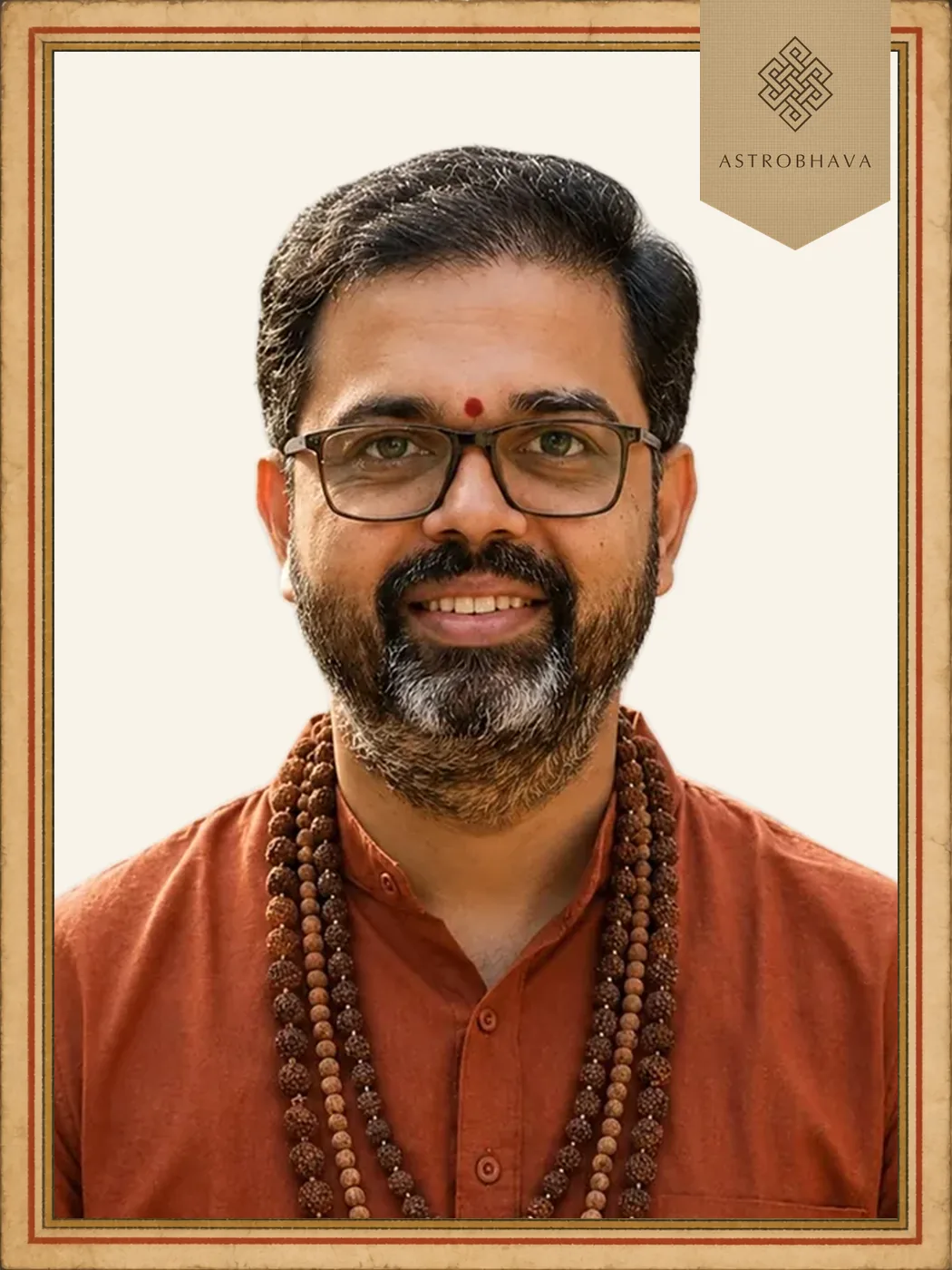
Under the guidance of Brahmashree Shivaaya
Every priest who performs your Rudra rite is trained in a traditional Padashala and personally recruited by Brahmashree Shivaaya — Chief Operating Officer & Head of Astrological & Spiritual Solutions at AstroBhava. The Rudram must be chanted with exact svara; an error in intonation is not a small thing in this rite. Assembling a hundred and twenty-one priests who can hold it accurately for eleven days is not something most organisations can do at all. Your ritual is conducted at our own Yagna Ashram — never a rented venue.
Meet our priests →- Certified Vedic priests — trained in traditional Padashalas
- 100% Agama Vidhi — as prescribed in the scriptures
- One chart, one sankalpa, one fire — never a group ceremony
- Muhurta from your chart — date fixed to your birth details
- Free worldwide delivery — prasadam & energised Rudra Yantra
Choose your scale
These four are one rite at four scales, which is why they share this page. The deity, the hymn, the abhisheka and the offerings are the same in all of them. What changes is the number of complete rounds of the Rudram — and with it the number of priests, the number of kalasams and the number of days.
✓ Included with every package: the free energised Rudra Yantra, sealed in a silver amulet
All-inclusive — no shipping charges, no additions at checkout. See everything included →
We do not publish a figure for this rite, and the reason is not coyness. At this scale the cost genuinely varies — with how many priests must travel in and be housed for the days of the rite, the volume of materials, and the season. Quoting one number on a page would either overstate it for some devotees or understate it for others. We give you the whole figure, itemised, once we know those things. It is the same principle as the rest of this site: we would rather tell you the truth late than a convenient number early.
This rite is arranged with you directly, not bought from a page. An offering of this size is not something we take by card, and the priests it needs are committed months ahead. Send a request and Brahmashree Shivaaya’s office replies with the dates we can hold, the priests we can assemble, and how the offering is settled. Nothing is charged at this stage, and nothing is committed until you say so.
Request this rite
Tell us a little and we will come back to you directly — usually within one working day.
Laghu Rudra Homa
One day · approximately three hours- OpensRudrabhishekam — the abhisheka to the Shiva lingam that begins every Rudra rite.—
- PreparationLaghunyasam chanted, placing the mantra in the body before the recitation begins.—
- The recitationRudram, with Chamakam following it. Eleven rounds in all, at one kalasam.11 rounds
- ClosesRudrabhishekam again, sealing what the recitation raised.—
11 rounds of Rudram · 4 priests · 1 kalasam
Ekadashani Rudra Homa
One day · approximately five hours- OpensRudrabhishekam.—
- PreparationMahanyasam chanted once — the full form of the placement, not the abridged Laghunyasam.—
- The recitationRudram at eleven kalasams, with Chamakam following at periodic intervals. Eleven priests, twelve rounds each.132 rounds
- ClosesRudrabhishekam.—
11 priests × 12 rounds each = 132 rounds · 11 kalasam
Maha Rudram
Six days · eight hours a day, seventy-two in all- Each day opensRudrabhishekam, then Mahanyasam. Every one of the six days begins this way.—
- Each day's recitationRudram at eleven kalasams, Chamakam following at periodic intervals.—
- Across the six daysEach of the eleven priests completes a hundred and thirty-two rounds.1,452 rounds
- Each day closesRudrabhishekam.—
- The final closeVasordhara Homa — the unbroken stream of ghee — then the last Rudrabhishekam.—
11 priests × 132 rounds each = 1,452 rounds · 11 kalasam
Athi Rudra Maha Homa
Eleven days · six hours a day, seven on the last- Each day opensRudrabhishekam, then Mahanyasam. Every one of the eleven days begins this way.—
- The fireEleven homa kundams burning together, at eleven kalasams.11 kundams
- Each day's recitationEach of the hundred and twenty-one priests chants Rudram eleven times, with Chamakam following at periodic intervals.1,331 rounds a day
- Across the eleven daysThe daily count, repeated.14,641 rounds
- Each day closesRudrabhishekam.—
- The final closeThe eleventh day runs an hour longer and ends with the Vasordhara Homa and the last Rudrabhishekam.—
121 priests × 11 rounds a day × 11 days = 14,641 rounds · 11 kundams
| Rite | Rounds | Priests | Days | Kalasam | Nyasam | Price |
|---|---|---|---|---|---|---|
| Laghu Rudra Homa | 11 | 4 | 1 | 1 | Laghunyasam | $1,340 |
| Ekadashani Rudra Homa | 132 | 11 | 1 | 11 | Mahanyasam | $3,940 |
| Maha Rudram | 1,452 | 11 | 6 | 11 | Mahanyasam | $38,480 |
| Athi Rudra Maha Homa | 14,641 | 121 | 11 | 11 | Mahanyasam | By arrangement |
You book — and add birth details on the next page, straight after payment.
Within 24–48 working hours — your muhurta is confirmed by email. The two multi-day scales need longer; we agree the dates with you directly.
The day before — your telecast link arrives by email.
After the rite — tracking email with how and when to wear the Rudra Yantra.
The most auspicious days for a Rudra rite
Tradition holds certain days as especially potent for Shiva's worship. A rite performed on them is considered to carry heightened merit.
The great night of Shiva — the most auspicious date of the year for any Rudra rite.
The thirteenth lunar day, twice a month, held as Shiva's own window at dusk.
Rudra's weekday, and the traditional day to begin a Shiva observance.
Associated with Shiva across the Tamil tradition, recurring monthly.
The monsoon month given over to Shiva worship across much of India.
The new moon, classically chosen for rites performed on behalf of the departed.
You do not need to wait for one of these days. Whenever you book, our astrologers calculate the muhurta from your own birth chart — a date chosen for you personally, which tradition regards as more precise than a calendar date chosen for everyone. If you would like the rite on one of the days above, tell us at checkout and we will fix the muhurta within it.
What you receive
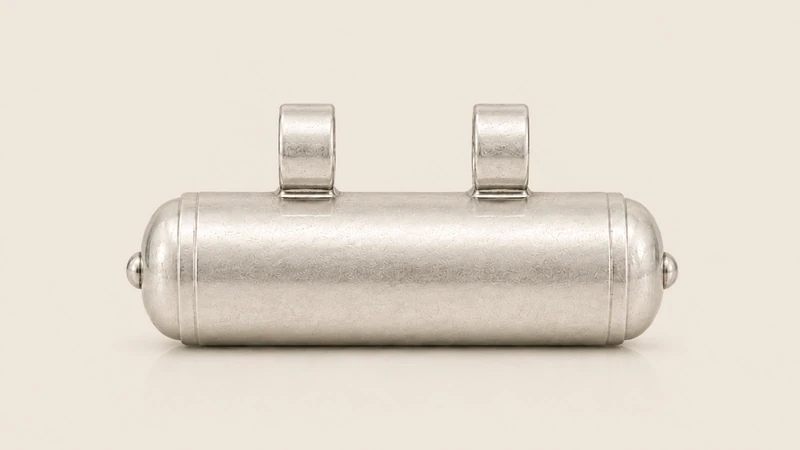
The sealing of the Rudra Yantra
The Rudra Yantra is consecrated over three days, then present through your rite to receive what the fire raises. When your rite concludes, it is rolled and locked inside its silver amulet according to Agama vidhi — the practice by which those energies are held within a consecrated object rather than dispersing. It is why a rite performed at our ashram can still reach a devotee ten thousand miles away: what the fire raised travels to you, sealed.
This is what arrives at your door, at no extra cost, with your prasadam.
Personal sankalpa
Your name, gotra and nakshatra — and up to four family members if you wish. Never a shared or group ritual, at any scale.
Hear yours read back, as the priest will say it →Live telecast, every day of it
Watch your own rite in real time from the ashram. The multi-day scales are telecast on each of their days, and recordings follow so nothing is lost to a timezone.
Free energised Rudra Yantra, sealed in a silver amulet
Shipped to you with your prasadam.
Prasadam, shipped free
Vibhuti from your own fire, sandalwood powder and kumkum — delivered to any country at no charge.
Rudram and Chamakam in full
Every round is the complete Namakam, all eleven anuvakas, with Chamakam following. Never an abridged recitation.
Rudrabhishekam on every day
Each day of a multi-day rite opens and closes with the abhisheka — it is not performed once at the start and left there.
A note on your telecast
The rite is telecast in full — from the sankalpa in which your name is spoken, through every round of the Rudram, to the abhisheka that closes it. Three hours in the Laghu Rudra, and across six or eleven consecutive days at the largest scales, live, with nothing performed off camera.
By default it is streamed openly on our YouTube channel so that devotees everywhere may witness the rituals — and because we believe you should be able to see our work before you trust us with yours. Your sankalpa names you and any family members you add, so if you would rather your ceremony were not public, choose the private telecast option at checkout and it is streamed as an unlisted link, which does not appear on our channel or in search, though anyone who has the link can watch it and share it.
How to wear your energised Rudra Yantra
Your auspicious time to wear it
Wear it for the first time on a Monday, between 6.30 and 7.30 in the morning. Bathe first, place the yantra on your pooja altar and offer your prayers, then wear it around your neck or your waist, on a red or black thread or a silver chain.
At a funeral
Take the yantra off before you attend a funeral.
Purify the amulet
Whenever the yantra has been taken off, or if it was worn at a funeral, dip it in raw milk or Ganga jal, show it incense, dhoop or attar (perfume), and then wear it again.
Keep the energy intact
You may repeat this energising once a week or once a month.
How your Rudra rite is performed
Fourteen stages, the same at every scale. The seventh is the Rudram itself, repeated as many rounds as your scale calls for.
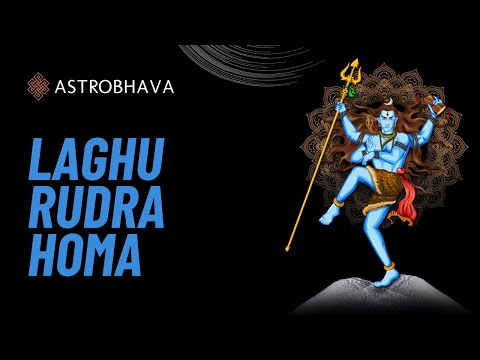 These fourteen stages, as they happenFrom a live telecast at our Yagna Ashram
Where the time goes
Every scale runs this same shape. The multi-day rites simply repeat it, once for each day.
- RudrabhishekamOpens the day
- NyasamLaghunyasam, or the full Mahanyasam
- Rudram → ChamakamRepeated — this is what is counted
- AhutiOfferings alongside the recitation
- RudrabhishekamCloses the day
- VasordharaOnly in the Maha Rudram and Athi Rudra, on the final day
Watch a real one: Laghu Rudra Homa · Ekadashani Rudra Homa — or see today's ceremonies before you book.
Sankalpa
Your name, gotra and nakshatra — and those of up to four family members — declared with the intention this rite is performed for.
Rudrabhishekam
The abhisheka to the Shiva lingam that opens the rite. In the multi-day scales it opens every single day.
Kalasha Sthapana
One consecrated pot in the Laghu Rudra, twelve in every larger scale, with Rudra invoked into them.
Ganapati Puja
Performed first, as tradition prescribes, so that obstruction is cleared before Rudra is approached.
Nyasam
Laghunyasam in the Laghu Rudra, the full Mahanyasam in every larger scale — the placement of the mantra in the body before the recitation may begin.
Agni Pratishtha
The fire consecrated in the homa kunda — one kunda, or eleven burning together in the Athi Rudra — and Agni invoked.
Sri Rudram — the Namakam
The heart of the rite. The eleven anuvakas of the Rudram, chanted in full, as many rounds as your scale calls for.
Chamakam
Follows the Rudram at periodic intervals throughout — the counterpart hymn, in which what Rudram propitiates is asked for.
Ahuti
Ghee, bilva, and the offerings proper to Rudra made into the fire alongside the recitation.
Rudrabhishekam again
Each day closes as it opened, with the abhisheka — so the recitation is held between two of them.
Vasordhara Homa
The unbroken stream of ghee poured into the fire that closes the Maha Rudram and the Athi Rudra.
Purnahuti
The final complete offering seals the sankalpa stated at the opening.
Yantra energisation
Your Rudra Yantra stands in the fire and is energised during the rite, then sealed in its silver amulet.
Aarti & Dispatch
Aarti performed live on your telecast. Vibhuti from your own fire and your sealed Rudra Yantra are packed and shipped free to your door.
Rudra — the fierce form, and the healing one
Rudra is Shiva as the Vedas name him, before the later mythology: the howler, the one in the storm, whose arrows bring disease and whose hand withdraws it. The Rudram addresses him in both aspects at once, which is the point of it — it does not ask him to stop being terrible, it salutes the terror and then asks for the medicine.
That is why these rites are booked for illness and for danger. The Mahamrityunjaya mantra, the conquering of death, is drawn from this same hymn.
Sri Rudram: the eleven anuvakas, Chamakam & how to chant
The full text with its meaning, the Namakam and Chamakam side by side, and how devotees chant at home — on our mantra guides.
Read the Mantra Guides →Ask before you book
The distance between eleven rounds and fourteen thousand is not a matter of budget but of what your situation calls for. Nirnaya, our free ritual guide, will tell you which the tradition indicates. For a full reading of your chart, book a live session with our astrologers.
Frequently asked
Your ritual date is an auspicious muhurta calculated personally for you — not a slot on a rota. Once it is confirmed, rescheduling from the customer's side is not available, and cancellation does not carry a refund. If we ever have to move your ritual for unforeseen reasons at the ashram, we will inform you immediately and provide a fresh auspicious date at no cost — and your telecast, recording, prasadam and yantra remain exactly as promised.
Read the full refund and cancellation policy.
Other rituals to Shiva
Rudrashtakam Homa
The eight verses of Tulsidas to Shiva, offered into fire — a different hymn, a shorter rite.
$3,947
Mrityunjaya Homa
The conquering-of-death mantra, drawn from the Rudram itself — for recovery and protection of life.
From $177
Chandrasekhara Ashtakam Homa
Shiva as the one who wears the moon — invoked for relief from acute distress.
$3,947Eleven anuvakas, returned to the fire
Book your Rudra rite, watch it performed live from our Yagna Ashram, and receive your energised Rudra Yantra anywhere in the world.
Choose Your Scale