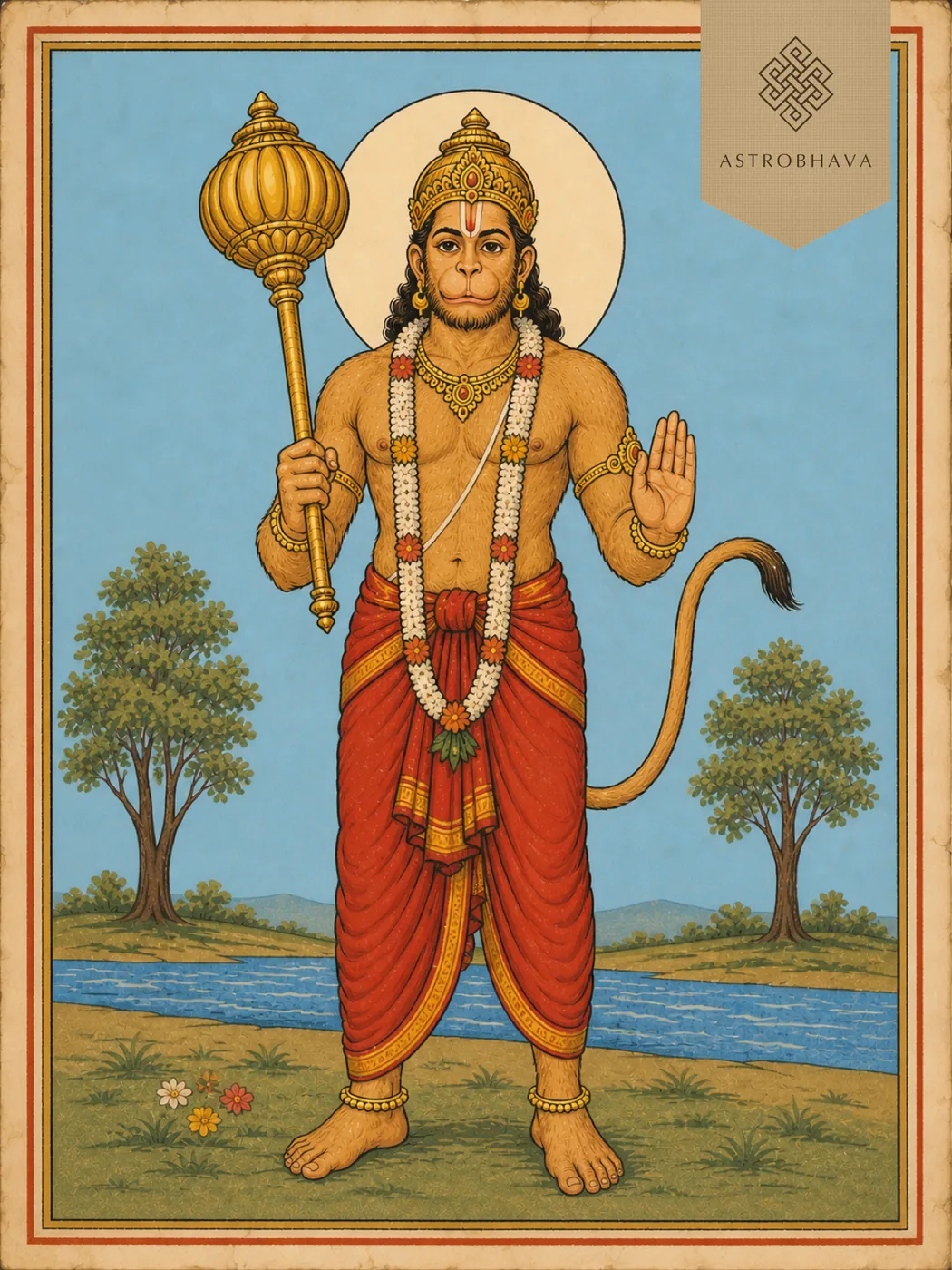
Bajrang Baan Mantra
निश्चय प्रेम प्रतीति ते विनय करें सनमान। तेहि के कारज सकल शुभ सिद्ध करें हनुमान॥ जय हनुमन्त सन्त हितकारी। सुन लीजै प्रभु अरज हमारी॥ जन के काज बिलम्ब न कीजै। आतुर दौरि महा सुख दीजै॥ जैसे कूदि सिन्धु महि पार। सुरसा बदन पैठि बिस्तार॥In Devanagari, Tamil, Telugu, Kannada, Malayalam and English — with the meaning of every word, and the one syllable most people pronounce wrongly.
Who Bajrang Baan is
Hanuman, invoked in the Bajrang Baan as the wielder of the thunderbolt body and the release of the arrow of devotion, appears here in his most martial and urgent aspect. The text, attributed to Tulsidas and circulating in the same Awadhi-Hindi stream as the Chalisa, addresses him as Bajrangbali—the one whose limbs are adamant—and calls upon him to bind hostile forces, to burn the nests of tormentors, and to stand as the living barrier around the reciter’s life. Unlike the Gayatri’s quiet turning of the intellect or the Chalisa’s expansive catalogue of virtues, the Baan is shaped as a directed missile of praise: each verse tightens the focus on Hanuman’s speed, his roar, his tail of fire, and his refusal to tolerate the enemies of Rama’s servants. The deity who emerges is still the son of Anjana and the wind, yet he is seen through the lens of protective ferocity that the word bāṇa—arrow—itself announces.
The Arrow of Bajrang
The Bajrang Baan is traditionally ascribed to Tulsidas and is understood within folk and Ramanandi circles as a composition formed when the poet required Hanuman’s swift intervention against obstacles that ordinary prayer had not removed. The title itself joins bajra—the adamantine quality of Hanuman’s body, already named in the Ramayana when Brahma and the gods bless the child—with bāṇa, the arrow. The poem therefore imagines praise itself as a projectile loosed toward the deity who is faster than thought. Internal references draw on the Sundara Kanda and the Yuddha Kanda: Hanuman’s leap, his discovery of Sita, his burning of Lanka with his flaming tail, his duel with Kalanemi, and his carrying of the herb mountain. Yet the Baan does not retell these episodes at leisure; it converts them into immediate epithets and commands addressed to the living presence of Bajrangbali. Manuscript and oral traditions vary in length and in the exact sequence of verses, but all versions retain the character of an urgent summons that asks Hanuman to act as both shield and weapon for those who keep Rama’s name. The text thus stands at the fierce edge of the same bhakti that produced the gentler Chalisa.
The mantra, in six scripts
The seed mantra, and the form most devotees chant daily. No initiation is required — it is open to anyone, including a parent chanting for a child.
- निश्चय
- niścaya — with certainty
- प्रेम
- prema — love
- प्रतीति
- pratīti — trust
- ते
- te — from / with
- विनय
- vinaya — humility
- करें
- kareṃ — they make
- सनमान
- sanamāna — reverence
- तेहि
- tehi — of that one
- के
- ke — of
- कारज
- kāraja — tasks
- सकल
- sakala — all
- शुभ
- śubha — auspicious
- सिद्ध
- siddha — accomplished
- करें
- kareṃ — makes
- हनुमान
- hanumāna — Hanuman
- जय
- jaya — victory
- हनुमन्त
- hanumanta — Hanumanta
- सन्त
- santa — of the good / saints
- हितकारी
- hitakārī — benefactor
- सुन
- suna — hear
- लीजै
- lījai — please take / accept
- प्रभु
- prabhu — lord
- अरज
- araja — petition
- हमारी
- hamārī — our
- जन
- jana — servant / devotee
- के
- ke — of
- काज
- kāja — task
- बिलम्ब
- bilamba — delay
- न
- na — not
- कीजै
- kījai — please do
- आतुर
- ātura — swiftly / eagerly
- दौरि
- dauri — having run
- महा
- mahā — great
- सुख
- sukha — ease
- दीजै
- dījai — please give
- जैसे
- jaise — as
- कूदि
- kūdi — leapt
- सिन्धु
- sindhu — ocean
- महि
- mahi — earth / across
- पार
- pāra — to the far shore
- सुरसा
- surasā — Surasa
- बदन
- badana — mouth
- पैठि
- paiṭhi — having entered
- बिस्तार
- bistāra — expansion
The syllable people get wrong
In bajraṅga the velar nasal ṅ before ga must be formed at the back of the tongue; reciters often replace it with a simple dental n, yielding “bajranga” that loses the resonant stop proper to the adamantine body the name itself declares.
When Bajrang Baan is chanted
Weekday. Tuesday
Festival. Hanuman Jayanti
Questions
Have your chart read before you decide
Chanting is yours to do, and free. But which deity your situation calls for — and whether a mantra alone is the right response — depends on your chart. Sometimes it is; sometimes it is not.
- Over 30 years in the Guru–Sishya Parampara, from the age of five
- He reads every chart himself — 60 minutes, one to one, never delegated
- Charts are read only between sunrise and sunset, following tradition
Related
Chanting is yours to do. Some things are performed for you.
Where a matter carries real weight — an examination that decides a course, a performance, a child whose studies have stalled — devotees sponsor the homa alongside their own practice. Performed for you and any family members you name, at our Yagna Ashram, in your name and gotra, on a muhurta calculated from your chart, and telecast live so you can watch it done for you.