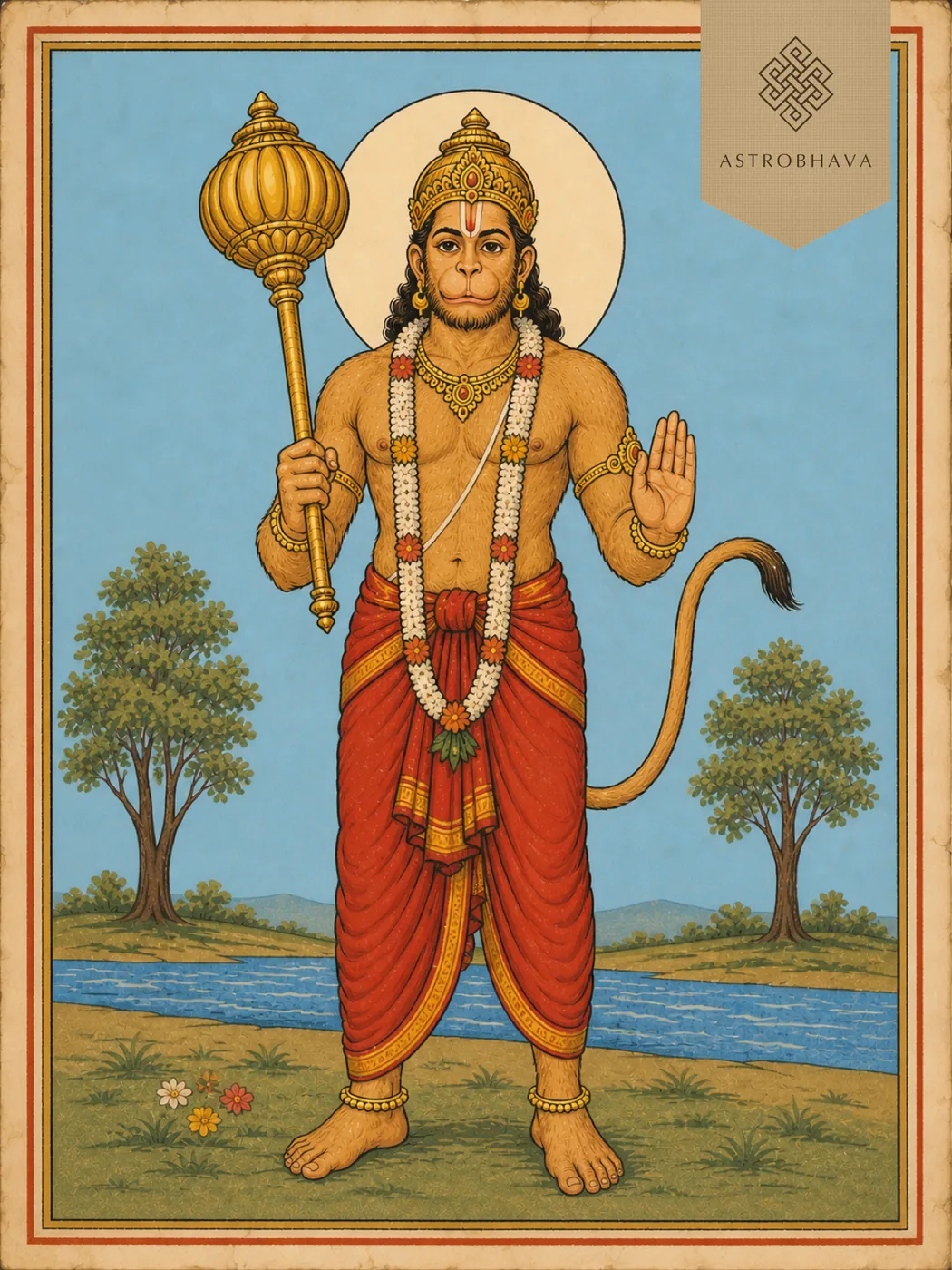
Hanuman Chalisa Mantra
श्रीगुरु चरन सरोज रज निज मनु मुकुरु सुधारि। बरनउँ रघुबर बिमल जसु जो दायकु फल चारि॥ बुद्धिहीन तनु जानिके सुमिरौं पवनकुमार। बल बुधि बिद्या देहु मोहिं हरहु कलेस बिकार॥ जय हनुमान ज्ञान गुन सागर। जय कपीस तिहुँ लोक उजागर॥In Devanagari, Tamil, Telugu, Kannada, Malayalam and English — with the meaning of every word, and the one syllable most people pronounce wrongly.
Who Hanuman Chalisa is
Hanuman, celebrated throughout the forty chaupais of Tulsidas’s Chalisa, is the devotee whose strength is measured only by his remembrance of Rama. The poem never separates the servant from the master: every feat—the burning of Lanka, the carrying of the mountain, the tearing open of his own chest—is narrated as an act performed inside Rama’s service. Composed in Awadhi rather than Sanskrit, the Chalisa belongs to the vernacular bhakti stream that made Hanuman the accessible guardian of ordinary households across North India. Its Hanuman is not the abstract Vāyuputra of the Gayatri alone, nor the fierce archer of the Bajrang Baan; he is the living presence who remains wherever Rama’s name is spoken, the one whose grace is described as constantly near the tongue that repeats the Lord’s story. The text itself becomes the meeting-place between the vanara of the epic and the household deity of later centuries.
Tulsidas and the Forty Verses
Tradition held inside the Ramanandi sampradaya and recorded in the Bhaktamal commentaries states that Tulsidas composed the Hanuman Chalisa during a period of confinement at the court of the Mughal emperor or, in another strand, during an imprisonment at Fatehpur Sikri. The poet, already the author of the Ramcharitmanas, turned to Hanuman as the swift messenger who could carry his appeal to Rama. The forty chaupais plus the opening and closing dohas were written in the same Awadhi register as the Manas, so that the language of village and court alike could hold the praise. Internal evidence links the poem to the Sundara Kanda episodes: the search for Sita, the confrontation with Ravana, the leap with the mountain Dronagiri. Yet the Chalisa is not a simple retelling; it compresses those deeds into a continuous address that moves from Hanuman’s childhood through his service to his present power to dwell where Rama’s fame is sung. After Tulsidas, the text spread through oral recitation in Hanuman temples from Ayodhya to Kashi, becoming the single most widely memorised devotional poem addressed to the son of Anjana in the Hindi-speaking world.
The mantra, in six scripts
The seed mantra, and the form most devotees chant daily. No initiation is required — it is open to anyone, including a parent chanting for a child.
- श्रीगुरु
- śrīguru — the revered guru
- चरन
- carana — feet
- सरोज
- saroja — lotus
- रज
- raja — dust
- निज
- nija — one’s own
- मनु
- manu — mind
- मुकुरु
- mukuru — mirror
- सुधारि
- sudhāri — having cleansed
- बरनउँ
- baranauṃ — I describe
- रघुबर
- raghubara — the best of Raghus (Rama)
- बिमल
- bimala — pure
- जसु
- jasu — fame
- जो
- jo — which
- दायकु
- dāyaku — giver
- फल
- phala — fruits
- चारि
- cāri — four
- बुद्धिहीन
- buddhihīna — without wisdom
- तनु
- tanu — body
- जानिके
- jānike — having known
- सुमिरौं
- sumirauṃ — I remember
- पवनकुमार
- pavanakumāra — son of the wind
- बल
- bala — strength
- बुधि
- budhi — wisdom
- बिद्या
- bidyā — knowledge
- देहु
- dehu — give
- मोहिं
- mohiṃ — to me
- हरहु
- harahu — remove
- कलेस
- kalesa — afflictions
- बिकार
- bikāra — distortions
- जय
- jaya — victory
- हनुमान
- hanumāna — Hanuman
- ज्ञान
- jñāna — knowledge
- गुन
- guna — virtue
- सागर
- sāgara — ocean
- कपीस
- kapīsa — lord of monkeys
- तिहुँ
- tihũ — three
- लोक
- loka — worlds
- उजागर
- ujāgara — illuminator
The syllable people get wrong
In pavanakumāra the medial va of pava must remain a lightly touched labial glide; many reciters harden it into a full stop “pabana,” splitting the wind-god’s name into an unrecognisable shape and losing the continuous breath implied by Vayu’s own presence inside the compound.
When Hanuman Chalisa is chanted
Weekday. Tuesday
Festival. Hanuman Jayanti
Questions
Have your chart read before you decide
Chanting is yours to do, and free. But which deity your situation calls for — and whether a mantra alone is the right response — depends on your chart. Sometimes it is; sometimes it is not.
- Over 30 years in the Guru–Sishya Parampara, from the age of five
- He reads every chart himself — 60 minutes, one to one, never delegated
- Charts are read only between sunrise and sunset, following tradition
Related
Chanting is yours to do. Some things are performed for you.
Where a matter carries real weight — an examination that decides a course, a performance, a child whose studies have stalled — devotees sponsor the homa alongside their own practice. Performed for you and any family members you name, at our Yagna Ashram, in your name and gotra, on a muhurta calculated from your chart, and telecast live so you can watch it done for you.