Bhairavi Mantra
Who Bhairavi is, the tradition this mantra belongs to, and how it is received from a teacher. The mantra itself is given at initiation and is not printed here.
Who Bhairavi is
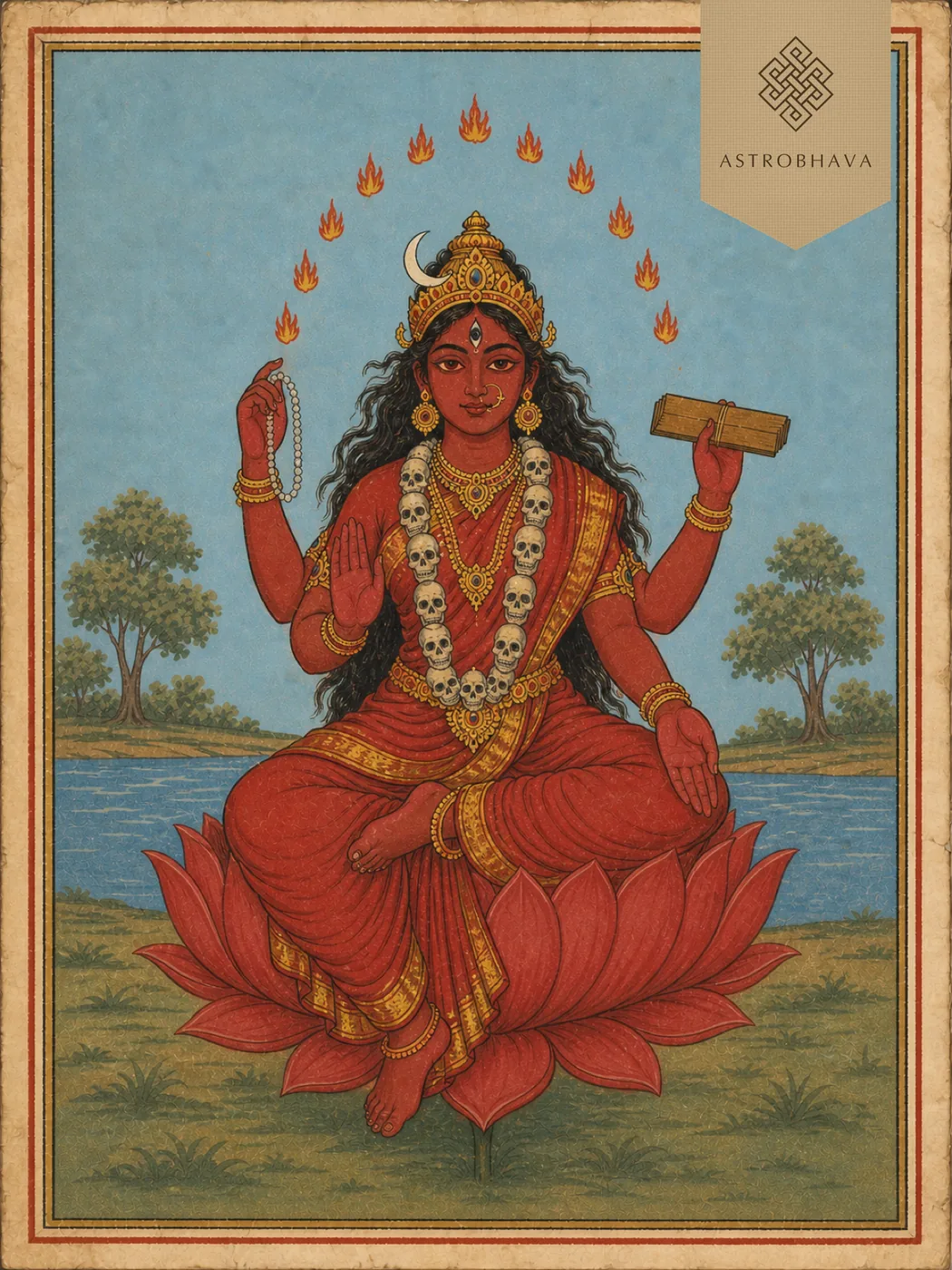
Bhairavi, also called Tripura Bhairavi, is the fifth of the ten Mahavidyas in their most common order. Her name is the feminine of Bhairava, the terrifying form of Shiva, and she stands beside him as his counterpart. The texts describe her as radiant as a thousand rising suns, robed in red, three-eyed, with a crescent moon in her hair and a garland of severed heads. Two of her hands hold a book and a rosary; the other two make the gestures that grant boons and dispel fear. She is seated on a red lotus. Tantric writers make her the heat of tapas, the burning discipline that consumes what is impure, and she is also called Shubhankari, the one who brings about what is auspicious, a name that holds her fierceness and her kindness together.
The discipline of heat
Because she is tapas itself, her practice is austere in character. Her mantra is received from a teacher, often within a fixed course of japa kept with a simple diet, measured speech and regular hours, the way a formal purashcharana is kept. Tradition reads the fierceness of her image as turned inward, at the inertia and delay in the one who worships her, and not at anyone else. A teacher gives her mantra when they judge that a student’s practice can hold that heat, and devotees in the Tantric lineages have long regarded her as the goddess of the practitioner’s own effort, the one invoked when resolve has grown cold.
The mantra itself
This mantra is given at initiation. Tradition transmits it from teacher to disciple with the practice that belongs to it, so we do not publish it in full. A teacher who has the authority to give it will give it with its method.
When Bhairavi is chanted
Weekday. Friday
Have your chart read before you decide
Chanting is yours to do, and free. But which deity your situation calls for — and whether a mantra alone is the right response — depends on your chart. Sometimes it is; sometimes it is not.
- Over 30 years in the Guru–Sishya Parampara, from the age of five
- He reads every chart himself — 60 minutes, one to one, never delegated
- Charts are read only between sunrise and sunset, following tradition
Related
Chanting is yours to do. Some things are performed for you.
Where a matter carries real weight, devotees sponsor the homa alongside their own practice. Performed for you and any family members you name, at our Yagna Ashram, in your name and gotra, on a muhurta calculated from your chart, and telecast live so you can watch it done for you.