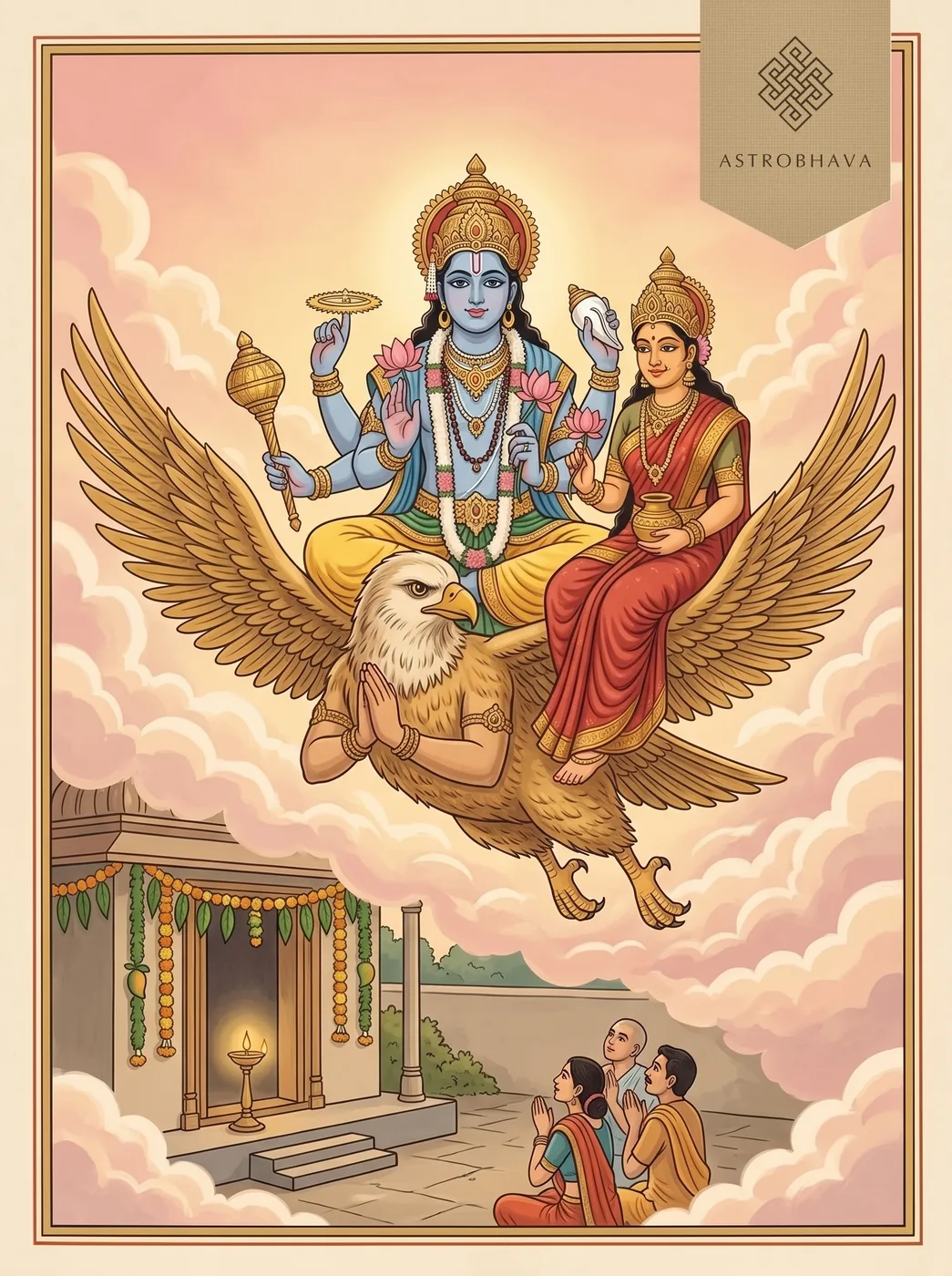
Mangalam Bhagavan Vishnu
मङ्गलं भगवान्विष्णुर्मङ्गलं गरुडध्वजः । मङ्गलं पुण्डरीकाक्षो मङ्गलायतनं हरिः ॥Also known as Mangalam Garudadhvajah
In Devanagari, Tamil, Telugu, Kannada, Malayalam and English — with the meaning of every word, and the one syllable most people pronounce wrongly.
 A reading of your birth chartBook →
What the Mangalam Bhagavan Vishnu is
Mangalam Bhagavan Vishnu is a single Sanskrit benediction in which the word mangalam, 'auspicious', opens every quarter and is tied each time to a different designation of Vishnu. No author is known. Its metre is the anushtubh, four quarters of eight syllables each, and it contains no verb, so it can be read either as a statement, 'Vishnu is auspicious', or as a wish that his auspiciousness be present. The first quarter names him Bhagavan Vishnu, the lord who pervades all. The second calls him Garudadhvaja, the one whose banner bears Garuda, the eagle who carries him. The third calls him Pundarikaksha, whose eyes are like the white lotus, the pundarika. The fourth turns the pattern around: instead of calling Hari auspicious, it calls him mangalayatanam, the very dwelling place of auspiciousness, so that the last line names the source of what the first three lines claim. In one printed collection it stands as the first of eight verses of the Shri Vishnu Ashtamangalam.
A blessing that travels without a book
No story of composition is attached to this verse, and no printed edition gives it a fixed place in a Purana with chapter and verse. Its history is a record of the collections and rites that use it. In the Shri Vishnu Ashtamangalam it opens a chain of eight verses whose later lines move from Vishnu to particular forms and shrines: Rama as the brother of Lakshmana, Padmanabha, Ranganatha, Krishna as the son of Devaki and the beloved of Radha, and finally Badarinatha and Muktinatha. A sister form appears in Gaudiya Vaishnava ritual. Bhanu Swami's manual of the samskaras, which follows Gopala Bhatta Goswami's Sat Kriya Sara Dipika, prints a version whose middle lines read mangalam madhusudanah, mangalam hrishikesho'yam, and ascribes it to the Brihad Vishnu Purana. There it belongs to the mangala acharana, the prayers for auspiciousness said in the rites common to every samskara, after the worship of Vishnu and before the steps particular to a naming, a sacred thread or a wedding. In temple worship it closes the lamp offering. The Maha Mangala Aarati sequence of the DFW Hindu Temple Society in Texas sets it among the Mangala Arati verses, directly before Sarva Mangala Mangalye, with the Mahalakshmi Ashtakam following. In many homes the camphor aarti ends the same way, with Karpura Gauram, then this verse to Vishnu, then the verse to the Goddess.
The mantra, in six scripts
- मङ्गलं
- maṅgalaṃ — auspicious
- भगवान्विष्णुर्मङ्गलं
- bhagavānviṣṇurmaṅgalaṃ — is Lord Vishnu; auspicious
- गरुडध्वजः
- garuḍadhvajaḥ — the one with Garuda on his banner
- मङ्गलं
- maṅgalaṃ — auspicious
- पुण्डरीकाक्षो
- puṇḍarīkākṣo — the one with white-lotus eyes
- मङ्गलायतनं
- maṅgalāyatanaṃ — the dwelling place of auspiciousness
- हरिः
- hariḥ — Hari, Vishnu
Mangalam Bhagavan Vishnu lyrics in full
One verse of four quarters, each opening on mangalam.
All 1 verses, in Sanskrit, Tamil, Telugu, Kannada, Malayalam and English, each with its meaning. Choose a script:
Download the Mangalam Bhagavan Vishnu PDFAll 1 verses with their meanings, in Sanskrit. Free to print and keep.
मङ्गलं भगवान्विष्णुर्मङ्गलं गरुडध्वजः ।
मङ्गलं पुण्डरीकाक्षो मङ्गलायतनं हरिः ॥
மங்கலம் பகவாந்விஷ்ணுர்மங்கலம் கருடத்வஜஃ ।
மங்கலம் புண்டரீகாக்ஷோ மங்கலாயதநம் ஹரிஃ ॥
మఙ్గలం భగవాన్విష్ణుర్మఙ్గలం గరుడధ్వజః ।
మఙ్గలం పుణ్డరీకాక్షో మఙ్గలాయతనం హరిః ॥
ಮಙ್ಗಲಂ ಭಗವಾನ್ವಿಷ್ಣುರ್ಮಙ್ಗಲಂ ಗರುಡಧ್ವಜಃ ।
ಮಙ್ಗಲಂ ಪುಣ್ಡರೀಕಾಕ್ಷೋ ಮಙ್ಗಲಾಯತನಂ ಹರಿಃ ॥
മങ്ഗലം ഭഗവാന്വിഷ്ണുര്മങ്ഗലം ഗരുഡധ്വജഃ ।
മങ്ഗലം പുണ്ഡരീകാക്ഷോ മങ്ഗലായതനം ഹരിഃ ॥
maṅgalaṃ bhagavānviṣṇurmaṅgalaṃ garuḍadhvajaḥ |
maṅgalaṃ puṇḍarīkākṣo maṅgalāyatanaṃ hariḥ ||
Auspicious is Lord Vishnu; auspicious is he whose banner bears Garuda. Auspicious is the lotus-eyed one; Hari is the very home of all that is auspicious.
The syllable people get wrong
In पुण्डरीकाक्षो (puṇḍarīkākṣo) the ṇḍ is retroflex, with the tongue curled back, and both ī and ā are long; it is one compound, puṇḍarīka + akṣa, 'white lotus' + 'eye', so say pun-da-REE-kaak-sho without the break that turns it into 'pundari kakshah'.
When the Mangalam Bhagavan Vishnu is chanted
Weekday. Thursday
Questions
Have your chart read before you decide
Chanting is yours to do, and free. But which deity your situation calls for — and whether a mantra alone is the right response — depends on your chart. Sometimes it is; sometimes it is not.
- Over 30 years in the Guru–Sishya Parampara, from the age of five
- He reads every chart himself — 60 minutes, one to one, never delegated
- Charts are read only between sunrise and sunset, following tradition
