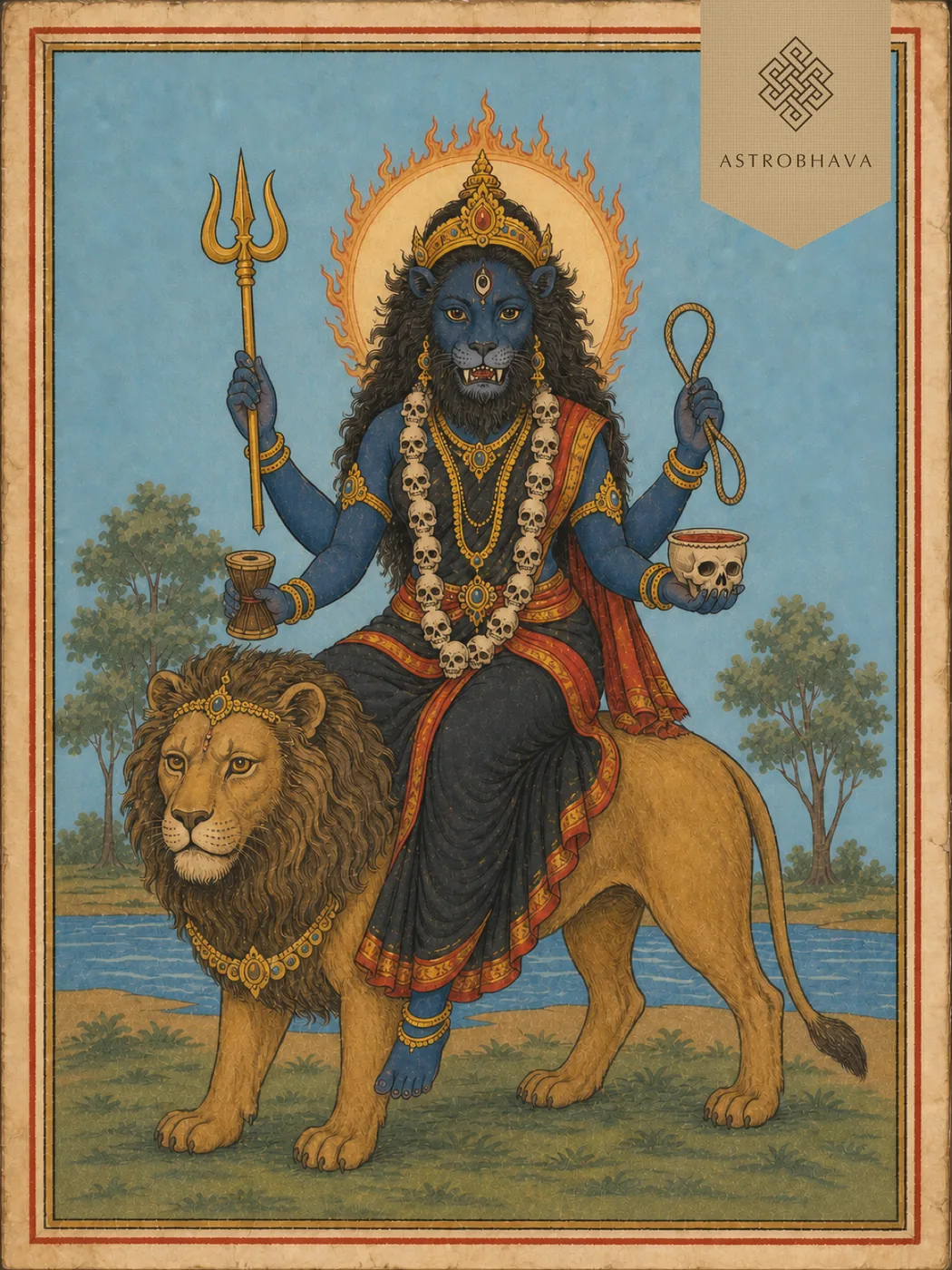
Pratyangira Mantra
Who Pratyangira is, the tradition this mantra belongs to, and how it is received from a teacher. The mantra itself is given at initiation and is not printed here.
Who Pratyangira is
Pratyangira is a fierce form of the Divine Mother with a lion’s head and a woman’s body, dark in colour, red-eyed, her hair loose. She is also called Narasimhini, and in the Vedic stream she is Atharvana Bhadrakali, the goddess of the Atharva Veda, the Veda that holds the old rites of protection and healing. Tradition links her name to two seers, Pratyangiras and Angiras, who are said to have first perceived her mantra in meditation. Accounts of her origin differ; one widely told story sets her in the aftermath of Narasimha’s fury at the killing of Hiranyakashipu, as the lion-headed power able to bring that fury to rest. Later tradition also identifies her with Nikumbhila, the goddess of the grove where, in the Ramayana, Ravana’s son Indrajit began a sacrifice that was broken off before it could be completed.
A practice kept under guidance
Tradition turns to Pratyangira where harm is believed to be deliberate: a hostile rite, or ill will sent towards a person or a household. Her name is often explained as “she who turns back”, and her mantra is regarded as one that returns such force towards where it came from. A practice of that kind is not handed out freely. It deals with harm, and it must never become a way of causing it, so a teacher gives the mantra together with the protective observances that belong to it and watches over how it is used. At her temple at Ayyavadi, near Kumbakonam, dried red chillies are offered in quantity into the fire of her homa.
The mantra itself
This mantra is given at initiation. Tradition transmits it from teacher to disciple with the practice that belongs to it, so we do not publish it in full. A teacher who has the authority to give it will give it with its method.
When Pratyangira is chanted
Weekday. Friday
Have your chart read before you decide
Chanting is yours to do, and free. But which deity your situation calls for — and whether a mantra alone is the right response — depends on your chart. Sometimes it is; sometimes it is not.
- Over 30 years in the Guru–Sishya Parampara, from the age of five
- He reads every chart himself — 60 minutes, one to one, never delegated
- Charts are read only between sunrise and sunset, following tradition
Related
Chanting is yours to do. Some things are performed for you.
Where a matter carries real weight, devotees sponsor the homa alongside their own practice. Performed for you and any family members you name, at our Yagna Ashram, in your name and gotra, on a muhurta calculated from your chart, and telecast live so you can watch it done for you.