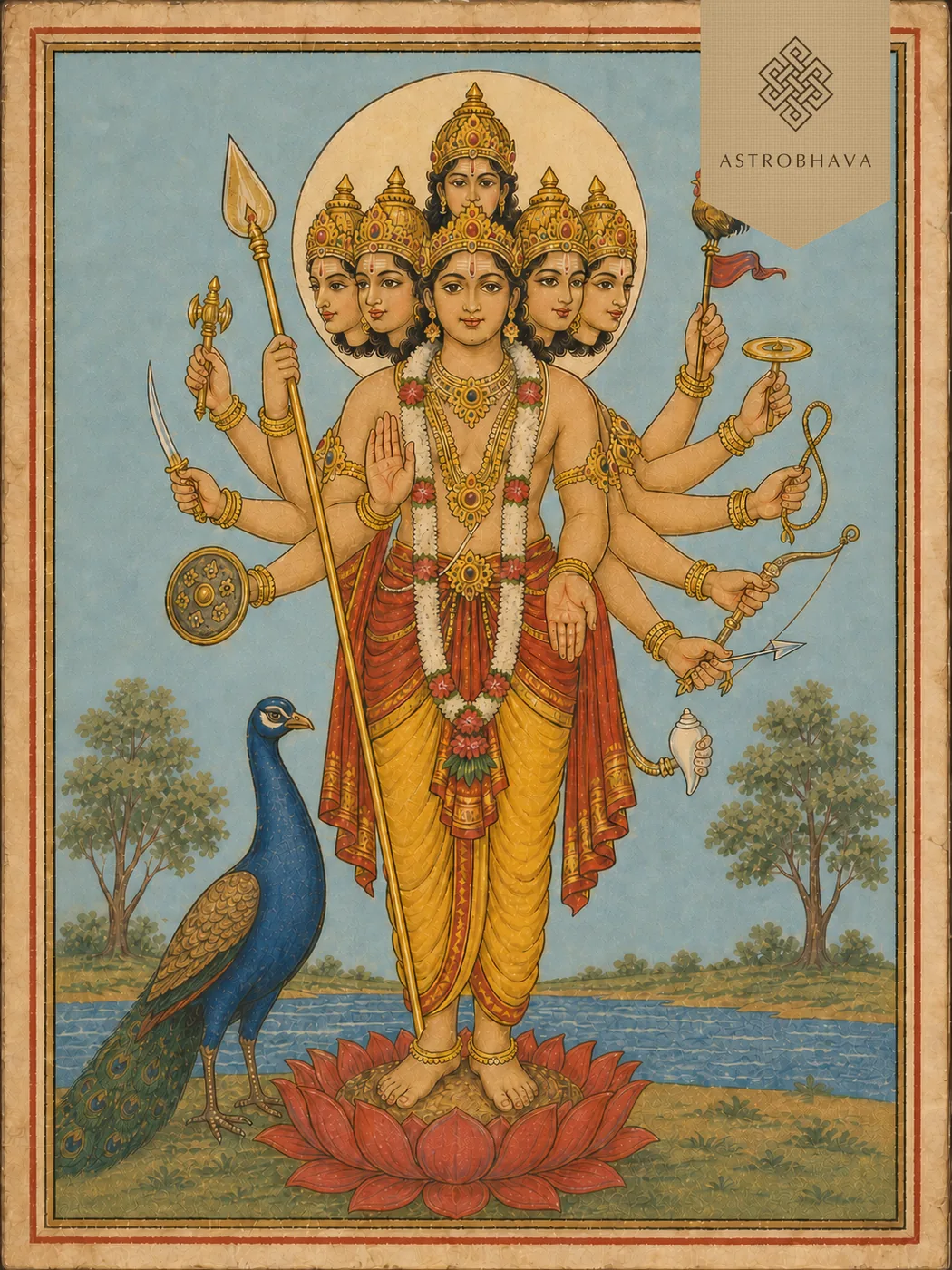
Kanda Sashti Kavacham Mantra
ॐ शरवणभवाय नमःIn Devanagari, Tamil, Telugu, Kannada, Malayalam and English — with the meaning of every word, and the one syllable most people pronounce wrongly.
Who Kanda Sashti Kavacham is
Kanda Sashti Kavacham names both a nineteenth-century Tamil hymn and the precise aspect of Murugan it clothes in sound. The deity addressed is Kanda, the six-faced commander born from Shiva’s sparks and reared in the Saravana marsh, whose victory over Surapadman is remembered across six liturgical days. Devaraya Swamigal composed the hymn at Tiruchendur after a vision in which the god’s vel traced protective lines over the poet’s own body. In the Tamil Shaiva imagination this Kanda is inseparable from that armour of verse: each couplet stations the lance before a limb, a sense, or a vital current. He is not the abstract war-god of the northern Skanda Purana alone, but the hill-deity of the six pāḍal petra sthalams whose very name, Kanda, is the Tamil phonetic body of Skanda, and whose kavacham remains the distinctive garment of his southern cult.
Armour Forged at Tiruchendur
The Kanda Puranam, Kachiyappa Sivachariyar’s fifteenth-century Tamil epic drawn from the Skanda Purana cycle, recounts that the asura Surapadman, shielded by boons, had seized the heavens. Shiva released six sparks from his third eye; Agni and Gangā bore them to the reed marsh Saravana, where they became six infants nursed by the Kṛttikās. Pārvatī gathered them into a single six-faced child, Kanda, and the gods placed the vel in his hand. For six days the young commander fought the asura hosts; on the sixth he clove Surapadman, whose halves became the peacock mount and the rooster standard. Centuries later, at the shore temple of Tiruchendur where that final battle is localized, the devotee Devaraya Swamigal received the Kanda Sashti Kavacham in a dream-command. The hymn re-enacts the six-day war as a bodily shield: the same vel that split the asura is invited to stand before skin, blood, nerves and breath. Thus the literary armour and the mythic victory remain one continuous liturgical act within the Tiruchendur tradition.
The mantra, in six scripts
The seed mantra, and the form most devotees chant daily. No initiation is required — it is open to anyone, including a parent chanting for a child.
- ॐ
- oṃ — the primordial seed-syllable
- शरवण
- śaravaṇa — the forest of reeds
- भवाय
- bhavāya — to the one who arose / was born
- नमः
- namaḥ — salutation
The syllable people get wrong
The retroflex ṇ in śaravaṇa is the trap. Speakers commonly dentalise it to an ordinary n, producing “sharavana” or even “sarawana,” which erases the curled-tongue contact that marks the marsh’s proper name. The ś must stay palatal, not collapse into a flat s.
When Kanda Sashti Kavacham is chanted
Weekday. Tuesday
Festival. Skanda Sashti
Questions
Have your chart read before you decide
Chanting is yours to do, and free. But which deity your situation calls for — and whether a mantra alone is the right response — depends on your chart. Sometimes it is; sometimes it is not.
- Over 30 years in the Guru–Sishya Parampara, from the age of five
- He reads every chart himself — 60 minutes, one to one, never delegated
- Charts are read only between sunrise and sunset, following tradition
Related
Chanting is yours to do. Some things are performed for you.
Where a matter carries real weight — an examination that decides a course, a performance, a child whose studies have stalled — devotees sponsor the homa alongside their own practice. Performed for you and any family members you name, at our Yagna Ashram, in your name and gotra, on a muhurta calculated from your chart, and telecast live so you can watch it done for you.