Yada Yada Hi Dharmasya
यदा यदा हि धर्मस्य ग्लानिर्भवति भारत । अभ्युत्थानमधर्मस्य तदात्मानं सृजाम्यहम् ॥Also known as Paritranaya Sadhunam
In Devanagari, Tamil, Telugu, Kannada, Malayalam and English — with the meaning of every word, and the one syllable most people pronounce wrongly.
 The Dasavathara Homa, performed for youBook →
What the Yada Yada Hi Dharmasya is
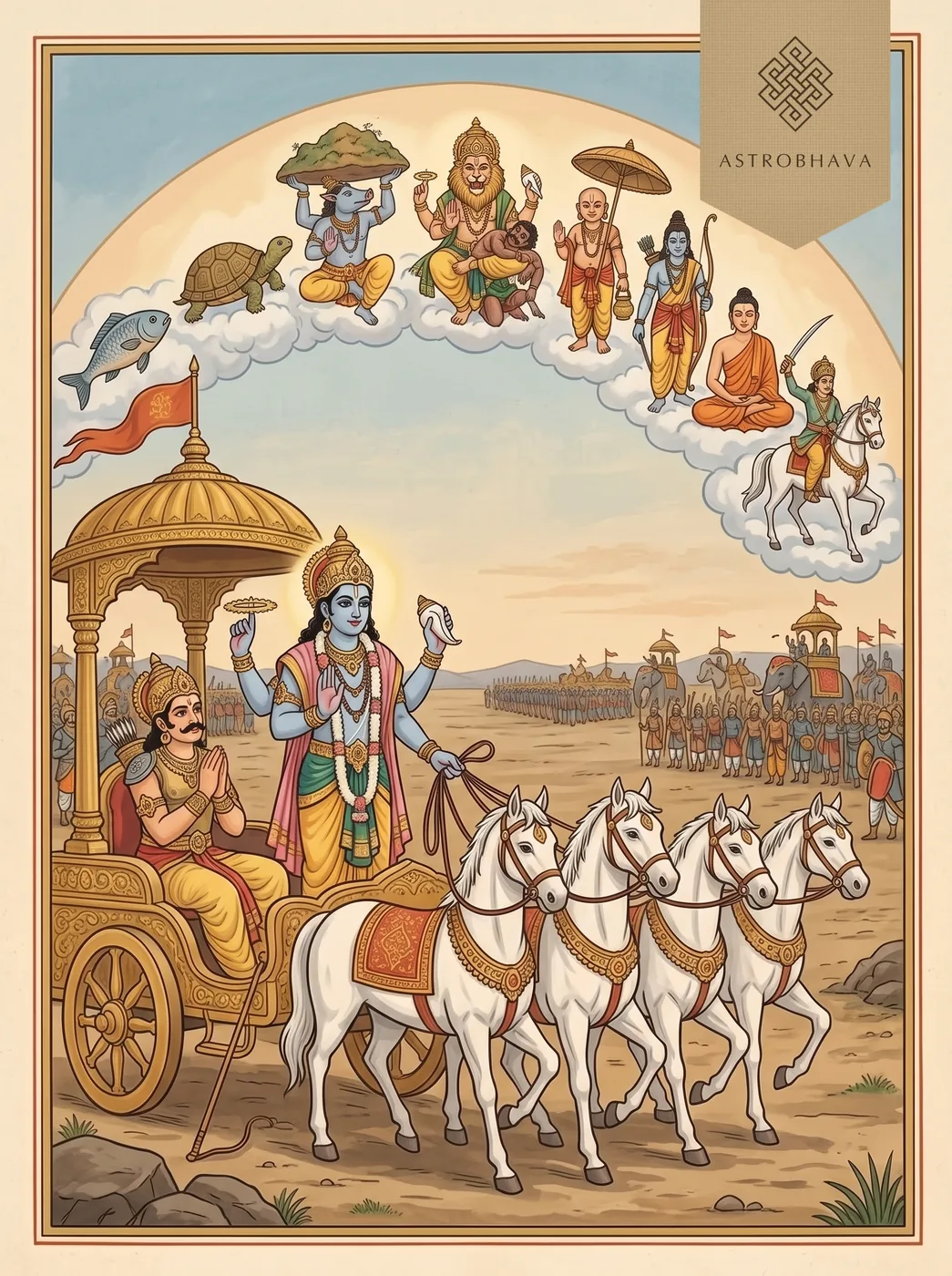
Yada yada hi dharmasya is the opening of the two verses in which Krishna tells Arjuna when and why he takes birth: Bhagavad Gita 4.7 and 4.8, the second of which begins 'Paritranaya sadhunam'. They stand in the fourth chapter of the Gita, Jnana Karma Sannyasa Yoga, which is itself part of the Bhishma Parva of the Mahabharata, a text tradition attributes to Vyasa. Each verse is a shloka of four eight-syllable quarters. The first answers 'when': whenever dharma suffers glani, a fading or loss, and adharma has its abhyutthana, its rising up, Krishna says, 'I send myself forth'. The second answers 'why' with three phrases of purpose: to protect the good, to destroy those who do wrong, and to set dharma firmly in place again. It closes on yuge yuge, age after age. Together the pair is the Gita's plainest statement of the idea of avatara, the deity coming down into the world, although the word avatara itself does not appear in either verse; the verbs Krishna uses are srijami, I send forth, and sambhavami, I come into being.
An answer to Arjuna's doubt about time
The verses answer an objection. Chapter four opens with Krishna saying that he once taught this imperishable yoga to Vivasvan, the sun, who passed it to Manu, who passed it to King Ikshvaku. Arjuna, beside him in the chariot at Kurukshetra, sees the difficulty: Krishna's birth is recent, in the house of Vasudeva as Shankara's commentary puts it, while Vivasvan was born at the beginning of creation, so how could Krishna have taught him? Krishna replies that both of them have passed through many births; he knows all of his, and Arjuna does not know his own. In verse 6 he adds that though he is unborn, undecaying and lord of all beings, he comes into being by governing his own nature through his own maya. Verses 7 and 8 then give the time and the purpose of those births, and verse 9 completes the thought: one who truly understands his divine birth and action is not born again after leaving this body. The commentators differ on the details. Shankara says Krishna becomes 'as if embodied, as if born', not born as ordinary beings are. Ramanuja holds that he takes birth by his own resolve, bound to no fixed time. Sridhara meets the charge that destroying wrongdoers is cruel with the image of a mother, whose fondling and scolding of a child come from the same love.
The mantra, in six scripts
- यदा
- yadā — when
- यदा
- yadā — whenever
- हि
- hi — indeed
- धर्मस्य
- dharmasya — of dharma, righteousness
- ग्लानिर्भवति
- glānirbhavati — decline comes about
- भारत
- bhārata — O Bharata (Arjuna)
- अभ्युत्थानमधर्मस्य
- abhyutthānamadharmasya — the rising up of adharma
- तदात्मानं
- tadātmānaṃ — then, myself
- सृजाम्यहम्
- sṛjāmyaham — I send forth
- परित्राणाय
- paritrāṇāya — for the protection
- साधूनां
- sādhūnāṃ — of the good
- विनाशाय
- vināśāya — for the destruction
- च
- ca — and
- दुष्कृताम्
- duṣkṛtām — of wrongdoers
- धर्मसंस्थापनार्थाय
- dharmasaṃsthāpanārthāya — to establish dharma firmly
- सम्भवामि
- sambhavāmi — I come into being
- युगे
- yuge — in age
- युगे
- yuge — after age
Yada Yada Hi Dharmasya lyrics in full
Both verses, Bhagavad Gita 4.7 and 4.8, as printed in the standard text of the Gita.
All 2 verses, in Sanskrit, Tamil, Telugu, Kannada, Malayalam and English, each with its meaning. Choose a script:
Download the Yada Yada Hi Dharmasya PDFAll 2 verses with their meanings, in Sanskrit. Free to print and keep.
यदा यदा हि धर्मस्य ग्लानिर्भवति भारत ।
अभ्युत्थानमधर्मस्य तदात्मानं सृजाम्यहम् ॥
யதா யதா ஹி தர்மஸ்ய க்லாநிர்பவதி பாரத ।
அப்யுத்தாநமதர்மஸ்ய ததாத்மாநம் ஸ்ருஜாம்யஹம் ॥
యదా యదా హి ధర్మస్య గ్లానిర్భవతి భారత ।
అభ్యుత్థానమధర్మస్య తదాత్మానం సృజామ్యహమ్ ॥
ಯದಾ ಯದಾ ಹಿ ಧರ್ಮಸ್ಯ ಗ್ಲಾನಿರ್ಭವತಿ ಭಾರತ ।
ಅಭ್ಯುತ್ಥಾನಮಧರ್ಮಸ್ಯ ತದಾತ್ಮಾನಂ ಸೃಜಾಮ್ಯಹಮ್ ॥
യദാ യദാ ഹി ധര്മസ്യ ഗ്ലാനിര്ഭവതി ഭാരത ।
അഭ്യുത്ഥാനമധര്മസ്യ തദാത്മാനം സൃജാമ്യഹമ് ॥
yadā yadā hi dharmasya glānirbhavati bhārata |
abhyutthānamadharmasya tadātmānaṃ sṛjāmyaham ||
O Arjuna, descendant of Bharata, whenever righteousness declines and unrighteousness rises up, at that time I bring Myself forth.
परित्राणाय साधूनां विनाशाय च दुष्कृताम् ।
धर्मसंस्थापनार्थाय सम्भवामि युगे युगे ॥
பரித்ராணாய ஸாதூநாம் விநாஶாய ச துஷ்க்ருதாம் ।
தர்மஸம்ஸ்தாபநார்தாய ஸம்பவாமி யுகே யுகே ॥
పరిత్రాణాయ సాధూనాం వినాశాయ చ దుష్కృతామ్ ।
ధర్మసంస్థాపనార్థాయ సమ్భవామి యుగే యుగే ॥
ಪರಿತ್ರಾಣಾಯ ಸಾಧೂನಾಂ ವಿನಾಶಾಯ ಚ ದುಷ್ಕೃತಾಮ್ ।
ಧರ್ಮಸಂಸ್ಥಾಪನಾರ್ಥಾಯ ಸಮ್ಭವಾಮಿ ಯುಗೇ ಯುಗೇ ॥
പരിത്രാണായ സാധൂനാം വിനാശായ ച ദുഷ്കൃതാമ് ।
ധര്മസംസ്ഥാപനാര്ഥായ സമ്ഭവാമി യുഗേ യുഗേ ॥
paritrāṇāya sādhūnāṃ vināśāya ca duṣkṛtām |
dharmasaṃsthāpanārthāya sambhavāmi yuge yuge ||
To protect the good, to destroy those who do evil, and to establish righteousness firmly again, I take birth age after age.
The syllable people get wrong
In glānirbhavati (ग्लानिर्भवति) the r is not optional: it is the visarga of glāniḥ turned into r before bh by sandhi, so say 'glaa-nir-bha-va-ti', with the first syllable long, rather than 'glaani bhavati'.
When the Yada Yada Hi Dharmasya is chanted
Weekday. Thursday
Festival. Gita Jayanti (Mokshada Ekadashi)
Questions
Have your chart read before you decide
Chanting is yours to do, and free. But which deity your situation calls for — and whether a mantra alone is the right response — depends on your chart. Sometimes it is; sometimes it is not.
- Over 30 years in the Guru–Sishya Parampara, from the age of five
- He reads every chart himself — 60 minutes, one to one, never delegated
- Charts are read only between sunrise and sunset, following tradition
