Durga Saptashati
All 700 verses, chapter by chapter, in six scripts — with the meaning of every verse and the order the text is read in.
 The Chandi Homa, performed for youBook →
What the Durga Saptashati is
The Durga Saptashati, named for its seven hundred verses, is the block of thirteen chapters that the Markandeya Purana calls, in its own chapter endings, the Devi Mahatmya, the greatness of the Goddess; in Bengal the same text is known simply as the Chandi. Most printings of the Purana set it at chapters 81 to 93, though other editions number them differently. An inscription of 608 CE already quotes it, and scholars place its composition between about 400 and 600 CE. Markandeya is the outer narrator, but most of the text is spoken by the sage Medhas, answering two men who have lost everything: Suratha, a deposed king, and Samadhi, a merchant thrown out by his own family. His answer to their grief is the story of Mahamaya, the power that clouds even the wise. It comes in three episodes. Chapter 1 has Vishnu kill Madhu and Kaitabha once the Goddess lets him wake. Chapters 2 to 4 tell her war with Mahishasura. Chapters 5 to 13 follow the fall of Shumbha and Nishumbha and their generals, the hymn of the gods, the Goddess's own account of what hearing these deeds brings, and the boons given to the two listeners. Of the thirty or so commentaries on it, Bhaskararaya's Guptavati is especially well known.
The thirteen chapters
Chapter 1: Madhu and Kaitabha slain
The king and the merchant meet Medhas; Brahma wakes Vishnu, who kills the two demons 104 verses
Chapter 2: Mahishasura's armies destroyed
The gods' anger becomes the Goddess; armed by each god, she routs the demon host 69 verses
Chapter 3: Mahishasura slain
His generals fall; Mahishasura changes shape again and again until she beheads him 44 verses
Chapter 4: Praise by Indra and the gods
Indra and the gods praise her and receive her promise to return when remembered 42 verses
Chapter 5: The Goddess and the messenger
The gods' hymn at the Himalaya; Kaushiki appears and tells Shumbha's envoy her vow 129 verses
Chapter 6: Dhumralochana slain
Sent to drag her to Shumbha, Dhumralochana is burnt to ash by her cry of 'hum' 24 verses
Chapter 7: Chanda and Munda slain
Kali springs from her brow, kills Chanda and Munda and is named Chamunda 27 verses
Chapter 8: Raktabija slain
The Mothers join the battle; Chamunda drinks the blood that keeps Raktabija alive 63 verses
Chapter 9: Nishumbha slain
Nishumbha falls to her dart; she beheads the warrior who springs from his heart 41 verses
Chapter 10: Shumbha slain
She draws the Mothers back into herself, fights Shumbha alone in the sky and kills him 32 verses
Chapter 11: The gods' hymn to Narayani
The gods' Narayani Stuti; she foretells her later forms, from Nanda's daughter to Bhramari 55 verses
Chapter 12: The fruit of the recitation
The Goddess herself says what hearing and reciting these deeds brings, then vanishes 41 verses
Chapter 13: Boons to Suratha and the merchant
Three years of worship on a river bank; the king and the merchant receive their boons 29 verses
The order it is read in
- Devi Kavacham — The armour hymn, first of the three preliminary texts in the standard printed order. The standard printed edition supports this order from the Yogaratnavali, which calls the Kavacham the seed, the Argala the power and the Kilaka the pin, the sequence in which every mantra is opened.
- Argala Stotram — The 'bolt' hymn. The Chidambara Samhita gives another order, reading the Argala and Kilaka first and the Kavacham after them.
- Kilak Stotram — The 'pin' that completes the preliminaries. Some lineages also say mantras for lifting the curse on the text (shapoddhara and utkilana) at this stage; the standard printed edition gives them and records that some scholars hold them unnecessary.
- Ratri Suktam (Vedic) — Rigveda 10.127. The Marichi Kalpa, quoted in the standard printed edition, puts the Ratri Sukta at the start, the Saptashati in the middle and the Devi Sukta at the end.
- Ratri Suktam (Tantric) — Brahma's praise of Yoganidra from chapter 1, printed again as a separate reading.
- Devyatharvashirsham — The Devi Atharvashirsha; the standard printed edition places it after the two Ratri Suktas.
- Navarna mantra, with its nyasa — The nine-syllable mantra of Chamunda. The standard printed edition sets it directly before and after the 700 verses, enclosing them, and rejects the custom of placing it before the Ratri Sukta.
- Saptashati nyasa and dhyana — The viniyoga and meditation for the whole text; each episode then opens with the dhyana of its own deity.
- The thirteen chapters — From 'Savarni, son of the Sun' in chapter 1 to 'Savarni will be Manu' at the close of chapter 13.
- Navarna mantra again (upasamhara) — The closing half of the enclosure around the 700 verses.
- Devi Suktam (Rigvedic) — Rigveda 10.125, the hymn of Vak, read first of the closing hymns.
- Devi Suktam (Tantric) — The 'ya devi sarvabhuteshu' hymn of chapter 5, printed again after the chapters.
- Pradhanika Rahasya — First of the three Rahasyas, the 'secrets' Medhas tells the king after the main text.
- Vaikritika Rahasya — Second of the Rahasyas.
- Murti Rahasya — Third of the Rahasyas. The standard printed edition counts the Kavacham, Argala, Kilaka and the three Rahasyas as the six limbs (angas) of the Saptashati.
- Kshama Prarthana — A short prayer asking pardon for any fault in the reading, which closes the sequence.
- Siddha Kunjika Stotram (in place of the limbs) — Printed as an appendix in the standard edition. Its own second verse says that with it the Kavacham, Argala, Kilaka and Rahasyas are not needed, and some readers use it instead of the full set. The standard printed edition's own advice is to follow the order handed down in one's lineage.
A deposed king, a merchant and the sage Medhas
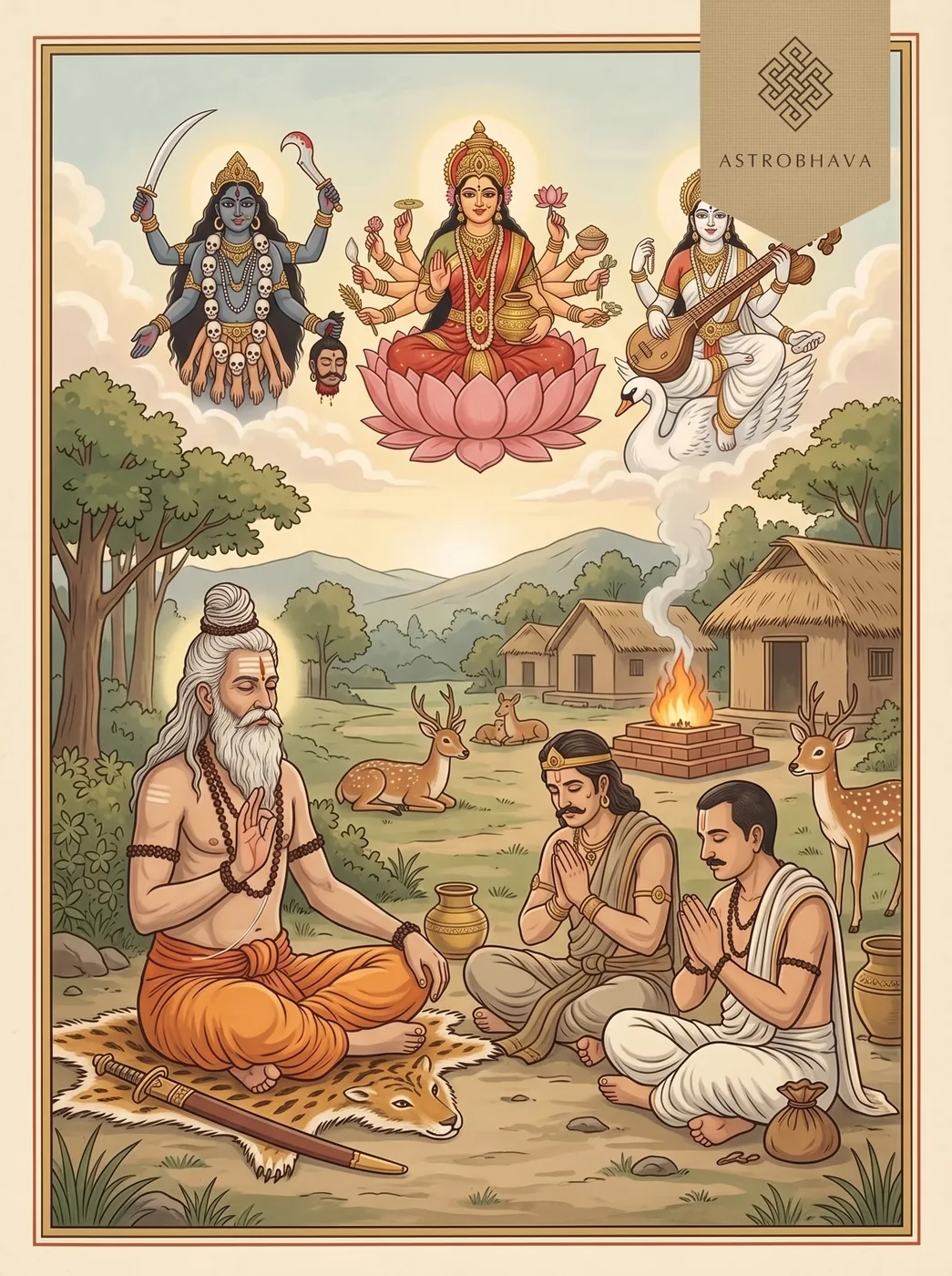
The Devi Mahatmya begins with Markandeya explaining how Savarni, son of the Sun, came to rule the eighth age of Manu, and goes back to that ruler's earlier life. In the age of Svarochisha, Suratha of the Chaitra line ruled the earth and cared for his subjects like his own children. Kings known as the Kolavidhvamsins made war on him and beat him, though their army was the smaller. Back in his capital his own ministers seized his treasury and troops, and he rode off alone into a dense forest on the pretext of a hunt. At the hermitage of the sage Medhas, where even the wild animals were calm, he stayed on, still fretting over his city and his chief elephant. Near the hermitage he met Samadhi, a merchant from a wealthy family whose wife and sons had taken his money and driven him out, yet who kept asking whether they were well. Together they asked Medhas why they still clung to what had failed them, and the rest of the book is his reply. In chapter 13 the two take his advice, shape an earthen image of the Goddess on a river bank and worship her there for three years. Suratha asks for a kingdom that will not be lost, and the text says he will be reborn as the Manu Savarni; Samadhi asks only for the knowledge that ends the sense of 'I' and 'mine'.
The syllable people get wrong
In Madhu and Kaitabha, the demon's name kaiṭabha (कैटभ) has a retroflex ṭ, made with the tongue curled back, and a breathed bh: say KAI-ṭa-bha, with ai as in 'aisle', not 'kay-tab'.
When the Durga Saptashati is chanted
Weekday. Friday
Festival. Navaratri, above all the autumn Sharad Navaratri and Durga Puja
Questions
Have your chart read before you decide
Chanting is yours to do, and free. But which deity your situation calls for — and whether a mantra alone is the right response — depends on your chart. Sometimes it is; sometimes it is not.
- Over 30 years in the Guru–Sishya Parampara, from the age of five
- He reads every chart himself — 60 minutes, one to one, never delegated
- Charts are read only between sunrise and sunset, following tradition
